
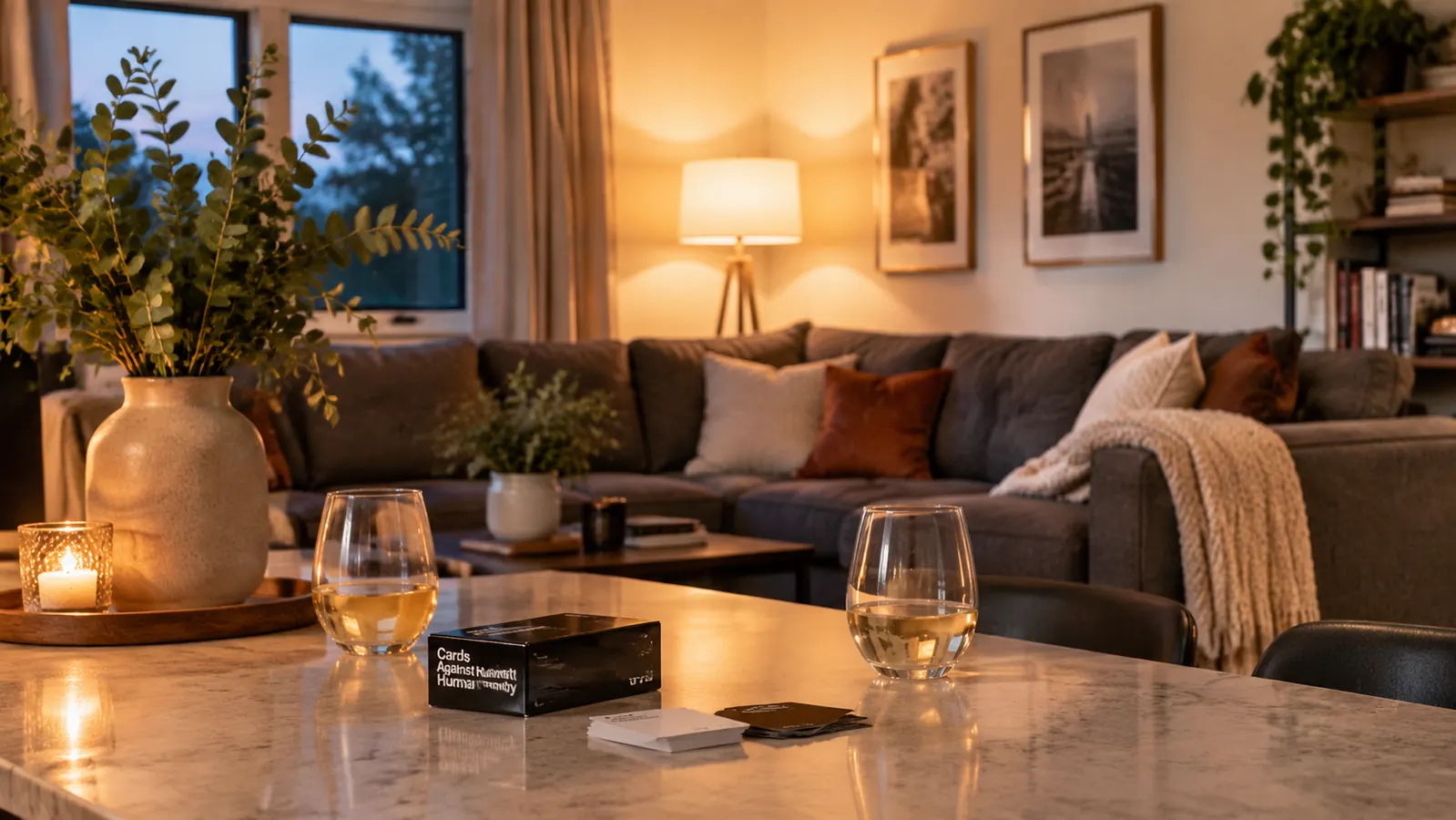
Marcus falls asleep on the couch by 9:30 if there is nothing planned. That is not a knock on my husband. It is what happens to a man who starts HVAC service calls at six in the morning and has been doing it for twenty years. For most of our marriage, Friday night at home looked the same: both of us on the sectional, one of us scrolling, a cooking show neither of us was actually watching, and by ten o'clock another week gone by with nothing in it worth remembering. Nobody was unhappy. It was just flat.
So we tried something that felt almost too small to matter. We put a two-player card game on the kitchen island and made it the entire plan. Not a movie plus a game plus a snack plus a real conversation. Just the game, about thirty minutes, the two of us. The one we landed on was Fox in the Forest from Renegade Game Studios, a trick-taking card game built for exactly two players. It has not fixed anything, because nothing was broken. What it did is give us something to do at 8:45 on a Friday that was not a screen.
Thirty minutes, two players, one small box on the kitchen island
Fox in the Forest is a two-player trick-taking card game from Renegade Game Studios, rated for ages 10 and up, with a stated playing time of 30 minutes. It is what we reach for when neither of us has the energy to plan anything bigger than clearing the counter.
Amazon Check Today's Price on Amazon →Step 1: Pick the night and say it out loud
Vague intentions die. "We should do a date night sometime" is not a plan, it is a wish with a nice sound to it. Marcus and I say the night out loud by Wednesday at the latest: Friday, after the kids are down, kitchen island. It takes four seconds and it is the difference between an evening that happens and an evening that quietly evaporates while one of us is looking for the good scissors.
Pick the night that matches your week, not the night that sounds romantic. In our house that is Friday, because Saturday still has a soccer game in it and Sunday has a school night on the other end of it. A school office manager and an HVAC tech do not need a perfect evening. We need one that does not require a recovery day.
Keep the plan small, too. The first few times I built the night up in my head until it had to be special, and then a long week made it feel like one more thing I had failed at. A thirty-minute card game is not a consolation prize for a bigger night out. It is the event. Once I started treating it that way, it started happening every week without anybody having to be talked into it.
One thing I got wrong early: I did every bit of the planning and then quietly resented it. Now we split it. I name the night, Marcus clears the island and gets the cards out. Two small jobs instead of one medium job that turns into a scoreboard.
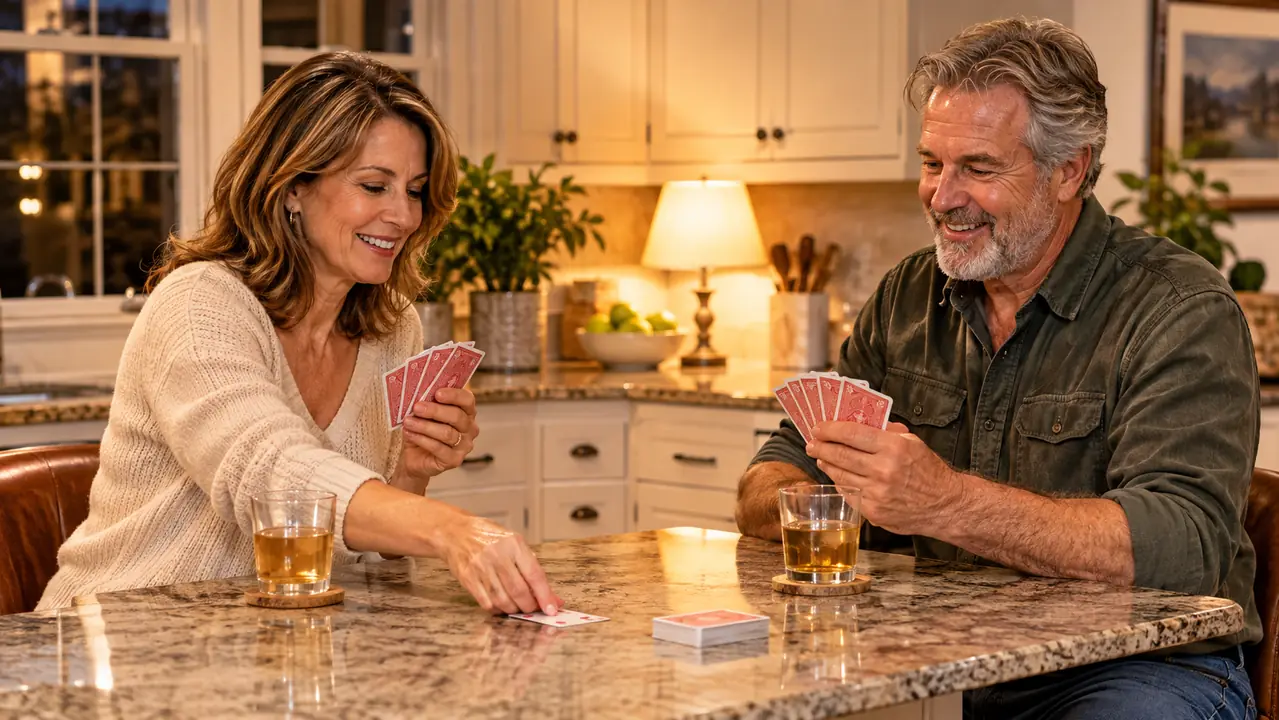
Step 2: Give the kids a finish line, not a fog
The kids are 15 and 11, which means bedtime is less about tucking anyone in and more about a short negotiation with a teenager. What finally worked was a finish line instead of a fog. At a set time, both of them are in their rooms. Not necessarily asleep, but in their rooms, doing whatever they do, with the hallway light off and the house shifted into its evening shape.
The 15-year-old needs the least management and the most warning. If I mention at dinner that we are doing our Friday thing at 8:30, she is on the stairs by 8:25 with an earbud in and no drama. The 11-year-old needs a countdown and a clear answer about the water glass. Yes, you can get water. Then you go back up. No conversation at the top of the stairs, because that is how a fifteen-minute window turns into an hour.
This is the part nobody warns you about. The first twenty minutes after the kids go to their rooms is when the whole evening usually dies, because one of you starts folding laundry and the other one starts answering work texts and suddenly it is 9:40 and nobody wants to learn anything. Decide ahead of time that the laundry waits. It is not laziness. It is closing out the day on purpose instead of letting it drain.
We also stopped announcing the night to the kids like it was an event. When it was a production, they treated it as a negotiation. Now it is simply what happens on Friday, and nobody argues with a thing that has always happened.
Step 3: Pick a game that fits the hour you actually have
This is where most at-home date nights fall apart. Somebody buys a big box game with a forty-page rulebook, reads it on a Tuesday, and it never comes out again. I have two of those in the hall closet right now and I am not proud of it. The game that survives a tired Friday is one you can set up in under a minute and finish in the time you actually have.
Fox in the Forest is a two-player trick-taking card game from Renegade Game Studios with a fairy tale theme, and it is the closest thing to a sure bet I have found. Trick-taking means you are winning and losing small hands inside every round, so there is a steady stream of small decisions to make, which is exactly what keeps two tired people awake and interested. The listing says the mechanics are designed so neither player gains an unfair advantage. After a year of Fridays, I believe it.
The specs matter more than they sound like they should. Two players is the entire design, not a variant tacked on so the box can say it. The stated playing time is 30 minutes, which is honest for a first round and shorter once you know the deck. It is rated for ages 10 and up, so our 11-year-old could technically sit in, though we do not let him. And the box is small enough to keep on the island without it turning into kitchen clutter.
One warning about picking by how a game looks on a shelf. We once bought a beautiful game about building a village and gave up halfway through setup twice. Pretty is not the same as playable on a Friday night when one of you has been on a ladder since seven in the morning.
A game that lives behind the vacuum does not get played. A game that is already on the counter when you walk into the kitchen gets played four Fridays out of five.
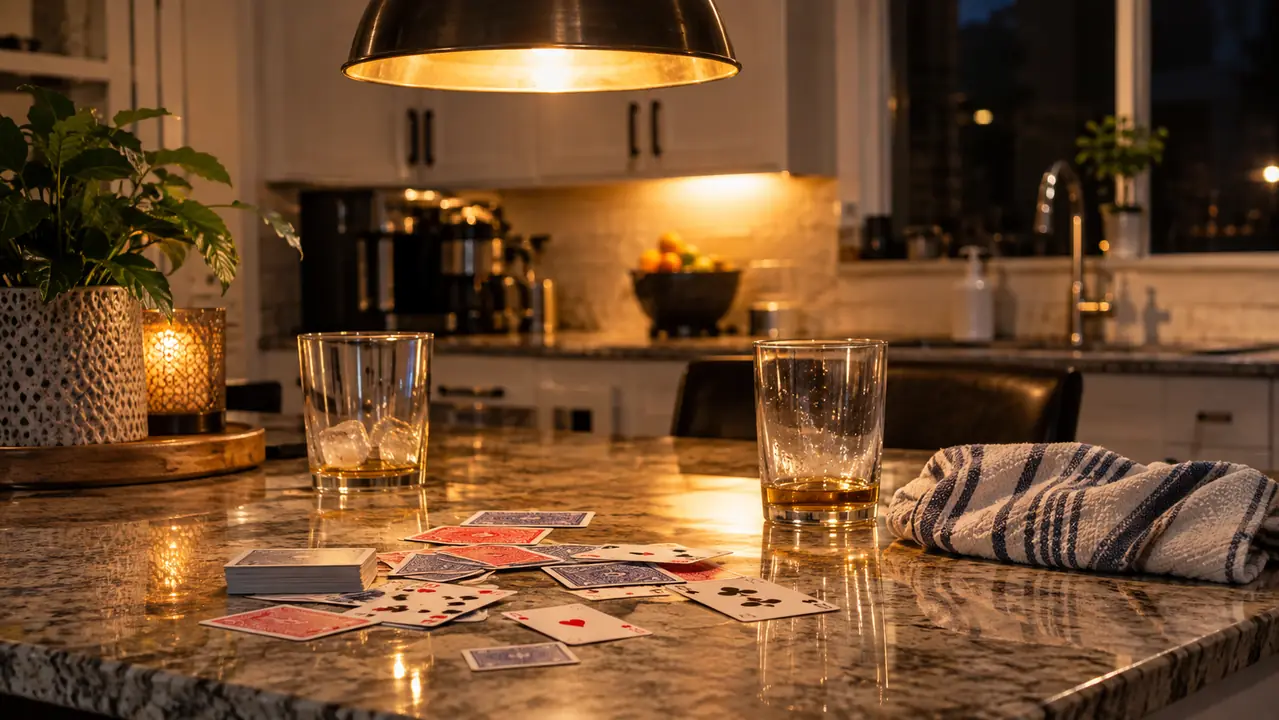
Step 4: Set the room up before you sit down
Setup takes five minutes and it is the difference between an evening and a chore. I clear the island, wipe it down, and put two glasses and something to eat on it before either of us sits down. If I wait until we are mid-game to think about snacks, we are not playing. We are administrating.
The Fox in the Forest box from Renegade Game Studios stays in the middle of the island, not on a shelf. This sounds like a small thing and it is not. A game that lives behind the vacuum does not get played. A game that is already on the counter when you walk into the kitchen gets played four Fridays out of five.
Phones go face down on the counter behind us, not on the island. Not in another room, because Marcus will get up to check it and then start a conversation about a furnace and we will not come back. Behind us is far enough. We also switch off the overhead light and use the lamp over the sink instead, because a bright kitchen at nine at night feels like a staff meeting.
The last setup job is where you sit. The sectional is right off the kitchen and the sectional is where evenings go to die, so we use the island stools instead. It is a small change that keeps the night from sliding into the exact same position as every other night of the week.
Step 5: Play two rounds, then stop
The first few times we did this, we tried to fit everything in: the game, then a show, then a real conversation about the future. That is a recipe for a 12:30 bedtime and a rough Saturday morning. Now we play, we sit for a few minutes after, and we go to bed. The evening ends before it turns into an obligation with a second act.
Two rounds is about right. Long enough to get past the clumsy first hand where neither of you remembers how the scoring works, short enough that Marcus is not asleep in his chair with cards in his hand. If it is going well, we play a third. If it is not going well, we stop after one, and that still counts as the date.
The other rule we landed on: nobody wins the evening. Early on I kept a running tally across weeks, which was fun for about a month and then got strange, because the score started deciding whether a night had been good. The point was never the tally. The point was that at nine o'clock on a Friday, both of us were in the same room, doing the same thing, with our hands busy.
There is a version of this advice that promises a card game will bring you closer, and I am not going to write that. What it does is lower the cost of an evening together. You do not have to plan a conversation or pick a movie or find a sitter. You have to clear a counter and deal.
What Else Helps
A snack you do not have to assemble. Cheese and crackers, pretzels, leftover pizza from dinner. Anything that can sit on the island for an hour without a plan or a plate that needs scrubbing. I stopped trying to make date-night food and the night got easier and honestly nicer.
A backup game. Swapping in something different one Friday a month keeps it from going stale, and keeping it in the same spot means nobody has to go digging through the closet at 9:15. We keep two on hand and alternate without discussing it much.
An ending. I know that sounds unromantic, but the nights that went badly were the ones with no end time. We give it about forty-five minutes on the island and then we are done, whatever is happening. A short good night beats a long mediocre one every single time.
And say something about it the next morning. Not as a check-in exercise, just in passing while the coffee is going. Marcus mentioning that Friday was a good one does more for next week than any reminder I could set on my phone.
The game that makes the plan easy enough to actually keep
Fox in the Forest is two players, a stated 30 minutes, ages 10 and up, and a box small enough to leave on the kitchen island between Fridays. It does not plan the night for you. It just removes the excuse.
Amazon Check Today's Price on Amazon →