

My short answer: for a weeknight at home, the Fox in the Forest card game from Renegade Game Studios is the better default, and Jaipur is the better pick for a long Saturday when neither of us is fading. I have played both at my kitchen island outside Columbus, usually on a Friday after the kids have disappeared into their rooms, and the gap between them is not quality. Both are well made and both are worth owning. The gap is what your evening actually looks like when you are in your forties, your husband has been in attics all day, and the couch is already calling your name.
Here is the part most comparisons skip. The two-player game that gets played in a real house is not the smartest one on the shelf. It is the one with the shortest distance between sitting down and shuffling. On a Friday at eight, that distance matters more than depth. Fox in the Forest is a single deck in a small box. You open it, you deal, you are playing. Jaipur asks you to sort and stack a set of pieces before the first turn and stack them again at the end. That sounds like nothing until you are tired, and then it is the reason a box stays in the closet for a month. That was our house for a while, and I am not proud of it.
The Two Games Side by Side
| Fox in the Forest | Jaipur | |
|---|---|---|
| Learning it | Trick-taking basics land in a round or two; the finer scoring takes a few games to click. | Two choices on your turn, take cards or sell cards. Taught in three minutes. |
| Footprint on the table | A deck and the tricks you have taken. That is the whole setup. | A market row plus several token stacks that have to stay sorted. |
| Setup and cleanup | Shuffle, deal, done. Ten seconds each way. | Sort and stack the pieces before and after every session. |
| Depth after twenty plays | A fixed deck. By the twentieth game the tricks start to feel familiar. | Rounds and shifting token values keep the math moving. |
| Luck versus planning | Knowing what has already left the deck rewards planning, though the draw still matters. | A thin market draw can decide a round before anyone is clever. |
| Packing it for a weekend away | Small box, cardstock only, light enough to drop in a tote. | Nothing fragile, but more pieces to keep track of in a hotel room. |
| Length of one session | About thirty minutes, and you can stop cleanly after a hand. | About thirty minutes for a full set of rounds. |
Where Fox in the Forest Wins
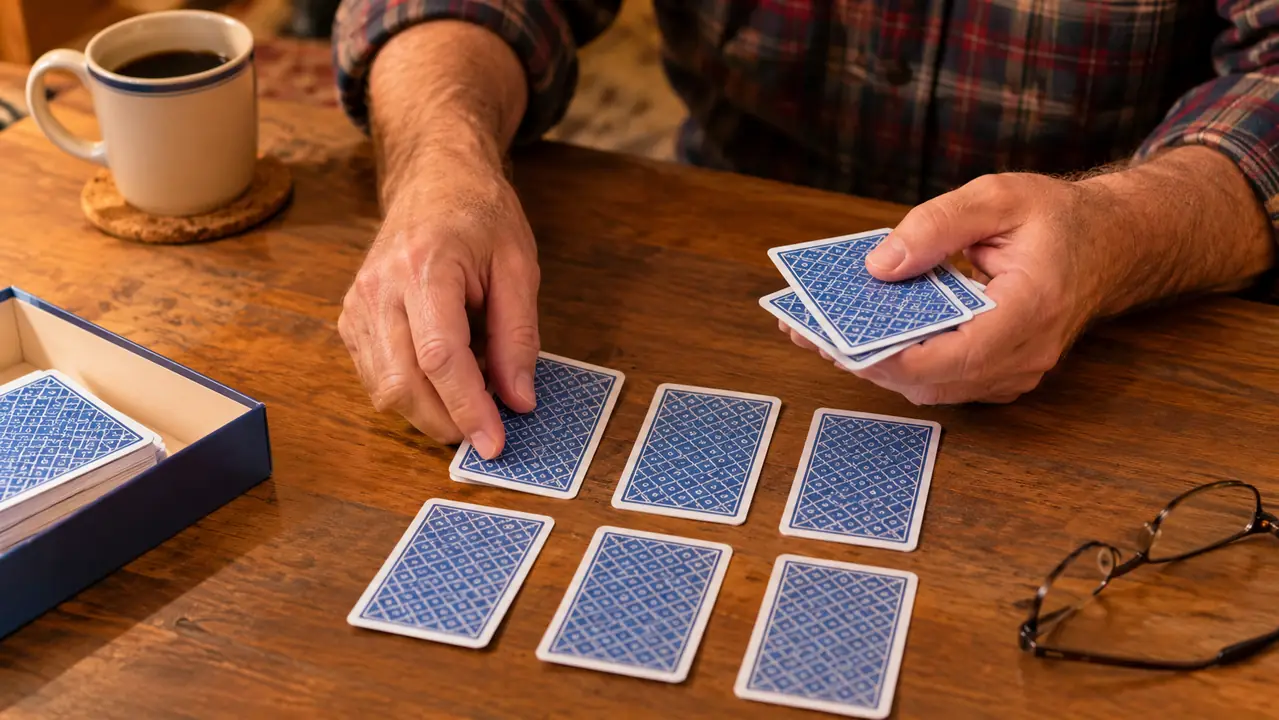
The first thing I noticed is how little ceremony there is. The box from Renegade Game Studios is small enough to live in the drawer of the end table, and at 0.16 kg it is not something you think twice about dropping in a tote bag. There is no board, no score pad, no pile of pieces to chase off the edge of the island when someone bumps the table. Cards get dealt, tricks get taken, cards go back in the box. I measured it once, because I am that person: the box is smaller than a paperback and about as heavy as a phone, so it sits in the end-table drawer beside the coasters with room left over. The cards are cardstock, and after two years of Friday shuffling ours have softened at the corners but none have split. If you have ever abandoned a game night because the setup felt like a chore, you already know why this matters more than the rulebook. The listing puts a session at thirty minutes for two players, and that matched us almost exactly once we knew what we were doing.
The second thing is the tone. It is a trick-taking game built around a fairy-tale theme, and it plays quiet. There is no market to haggle over and no race to grab the good pieces before your spouse does. You play cards, watch what has already left the table, and decide whether to take a trick or let it slide. The scoring rewards a middle path, which is a strange thing to get the hang of and a satisfying one. Marcus, who will tell anyone he is not a game person, said it felt less like competing and more like a puzzle the two of you are working at the same table. Then he was annoyed at how much he liked it, which from him is high praise.
It also handles a low-energy night gracefully. If one of us is distracted or the conversation keeps drifting, the game does not fall apart. There is no penalty for playing loosely and no long recovery from a bad decision. You finish a hand, you shrug, you deal again. Compare that to a game with a running score and a market you can wreck in one careless move, and you can see why this is the one I reach for when I am not sure how much energy the evening has in it. It is forgiving in a way that keeps the night pleasant instead of turning it into a competition with consequences.
Where Jaipur Wins
Jaipur wins on variety, and I will not pretend otherwise. It plays in rounds, and each round resets the market, so it does not settle into a rut the way a fixed deck eventually can. Twenty plays in, you still run into situations you have not seen before. There is a specific tension in that game, the moment where the market is thin and you have to decide whether to sell now for less or hold and hope the card you need is still in the pile. Marcus prefers it for exactly that reason. He likes the jostling. He likes that the game keeps handing him decisions with real cost attached, and he is better at that than I am, which he mentions.
It also feels more social in a louder way. Jaipur has pieces, and pieces make noise and take up space and give your hands something to do while you think. There is more table talk, more groaning when someone takes the card you were counting on, more reason to look up and make a face at each other. If your idea of a good evening involves good-natured arguing across the island, Jaipur delivers more of that than a quiet trick-taking game does. There was one Saturday in February, cold enough that neither of us wanted to go anywhere, where we played three full sets in a row and the pieces stayed out on the island the whole time. That was the game at its best. No sorting between sets, no rush, plenty of room to argue about whether I should have sold the card I sold. It was a genuinely good evening, and it only happened because we had the hours to give it. On a night when we are both running on fumes, that same game feels steeper than it should.
The Deck That Actually Reaches the Table on a Friday
One small box, one deck, about thirty minutes for two players, and nothing to sort before you start. If your game nights die during setup, this is the fix. Rated 4.6 from more than 3,600 reviews.
Amazon Check Today's Price on Amazon →
What a Friday Night Actually Looks Like
Our Fridays are not picturesque. The 15-year-old is in her room with headphones on, the 11-year-old is at my mother's or negotiating hard for one more hour of screen time, and Marcus comes in smelling faintly of ductwork. We eat at the kitchen island because it is closer than the dining table we never use. The game goes on the island after the plates are cleared. With Fox in the Forest that means wiping the crumbs and dealing. With Jaipur it means wiping the crumbs, sorting the pieces into their stacks, and then dealing. I know how that sounds. Multiply it by fifty Fridays and it is the whole reason one box has worn corners and the other still looks new.
Marcus is asleep on the couch by nine-thirty if nothing is planned. That is not a joke, it is the constraint the entire evening has to fit inside. A thirty-minute game is the right length for us, and both of these land there. Anything that takes an hour to teach and ninety minutes to play does not happen in this house, no matter how good it is. Fox in the Forest has the edge only because it can be stopped cleanly after a hand if he is fading, while Jaipur in the middle of a set of rounds feels like leaving a conversation halfway through. We learned that the hard way last fall, on a night we started at ten past nine thinking we had plenty of time. He was asleep between rounds with a piece still in his hand, and I finished the set alone at the island with the kitchen light buzzing. That is not what anyone means by a date night. Fox in the Forest has never done that to us, because ending after a hand is a normal way to stop rather than a surrender.
We landed on keeping both, which is the honest answer and also the one that takes up shelf space. Fox in the Forest is the Thursday, or the tired Friday. Jaipur is the Saturday when we start earlier and neither of us has anywhere to be in the morning. If you are buying one, and you are the person in the relationship who plans things, buy the one that survives contact with a tired spouse. Renegade Game Studios made the smaller commitment here, and in our house the smaller commitment is what actually gets used.
The game that gets played on a Friday is the one you can start in ten seconds, not the one with the better rulebook.
The Small Annoyances Nobody Mentions
Fox in the Forest has real weaknesses. The deck from Renegade Game Studios is fixed, so the tricks do eventually start to rhyme with each other. By our thirtieth game or so I could see the shape of a hand earlier than I used to, and some of the small suspense had drained out of it. We still play it, but it has become the comfort version of our game night rather than the interesting one, and I notice that more now than I did in the first year. There is luck in the draw too, and some hands are simply worse than others, which stings more in a game where restraint is the point. It is two players only, so it is no use on a family night with the kids, even though the box says ten years and up. And because it is quiet, it depends on the two of you actually talking. If the conversation is not there, the game will not manufacture one. It is a good game, not a personality.
Jaipur's weaknesses are the ones I already listed. Sorting the pieces is genuine friction on a weeknight, and a couple of them are small enough to vanish into a couch cushion, which in our living room is a when rather than an if. The market draw can decide a round before anyone has done anything clever, and that is maddening when you are the one losing. It also wants more table room than a deck of cards does, which matters if your date night happens on a sectional with a laptop on the ottoman and a kid's homework still spread across the far end.
Who Should Buy Which
Buy Fox in the Forest if your evenings are short and your energy is lower than your intentions. Buy it if you want something that lives in a drawer, travels in a tote, and reaches the table before the coffee goes cold. Buy it if you like trick-taking and want a two-player version that asks you to think rather than haggle. It is also the safer first purchase if your partner is not a game person, because the rules conversation takes a minute instead of ten and nobody has to feel foolish on a Friday night.
Buy Jaipur if you have the longer evening, the bigger table, and two people who enjoy a bit of back and forth. Buy it if you get bored of a game once you can see the shape of every hand. Buy it if you want more happening at the table, more noise, more reasons to look up at each other between turns. If you are choosing for a whole year of Fridays and you know you will want variety, that is the trade you are making, and it is a fair one. Just be honest with yourself about who does the cleanup in your house.
Start With the One That Fits in the End-Table Drawer
Two players, about thirty minutes, one deck, and nothing to sort. If the goal is more evenings actually spent playing instead of setting up, this is where I would start.
Amazon Check Today's Price on Amazon →