
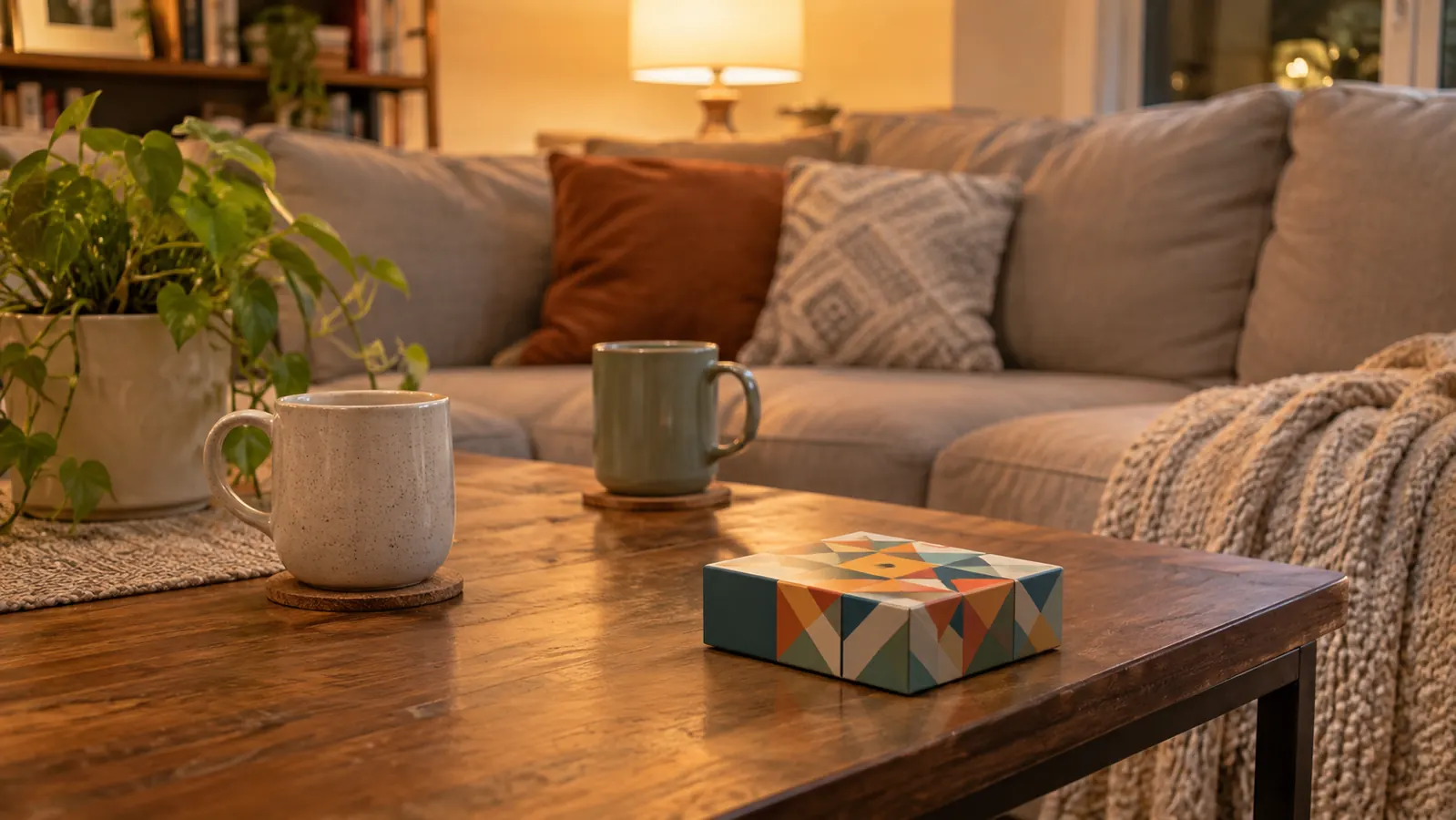
Marcus falls asleep on the couch at 9:30 if nothing is planned. That is not a complaint, it is just the truth about a man whose first HVAC service call starts at 6:15 in the morning. For a long stretch our Friday nights looked like this: he scrolled truck parts on his phone, I half-watched a show I could not summarize afterward if you paid me, and by ten o'clock we were both asleep in different rooms. Nobody was miserable. It was just flat. So we went looking for something small we could do together at the kitchen island that needed no sitter, no screen, and no two-hour commitment. Renegade Game Studios Fox in the Forest ended up being the one that stuck. It has lived in our house for months now, and the box is soft at the corners.
Here is what a card game can and cannot do. It will not rescue a rough week, and it will not settle the argument about the dishwasher. What it does is hand you a thirty-minute frame with a clear start and a clear finish, where both people are looking at the same thing instead of two different screens. For us that was the missing piece. This is what months of playing it at home actually looked like, including the parts that annoyed me.
The Quick Verdict
The two-player game we still reach for months later. One small box, thirty minutes, and no rulebook homework.
Amazon Check Today's Price →The Friday Night We Actually Show Up For
Two players, one small box on the kitchen island, and a clear finish so you can stop after one round without guilt.
Amazon Check Today's Price on Amazon →How I've Used It
We play most Friday or Saturday nights, usually after our eleven-year-old is in his room and our fifteen-year-old has claimed the living room television. That sounds unromantic. It is also the truth of a house with two kids and one adult who works early. We set up at the kitchen island because the overhead light is better there and the counter is tall enough to lean on. Renegade Game Studios lists it at thirty minutes for two players, and for us that estimate has been honest, including the first night when we read the rules out loud and fumbled through a round.
The rules take one sitting. I want to be specific about that, because we have bought games that demanded a forty-minute lecture before anyone had any fun. This one we opened, read through once, and played. The second night we did not open the rulebook at all. That matters more than any design detail I could describe, because the game you keep playing is the game you can start in two minutes when you are both tired and neither of you wants to be the one learning something new. Our fifteen-year-old has joined in twice when a friend canceled on her. The box says ten and up, and she picked up the strategy faster than I did, which she has mentioned more than once.
The one thing I would flag: we have never played it with anyone who dislikes card games. Marcus grew up playing euchre with his grandparents, so the format was familiar to him. I did not have that background, and it took me two or three games to stop asking which card I was meant to play. If you are the person in your house who usually loses at cards and hates that feeling, give it three nights before you decide it is not for you. One night is not enough information.
What Thirty Minutes Actually Feels Like
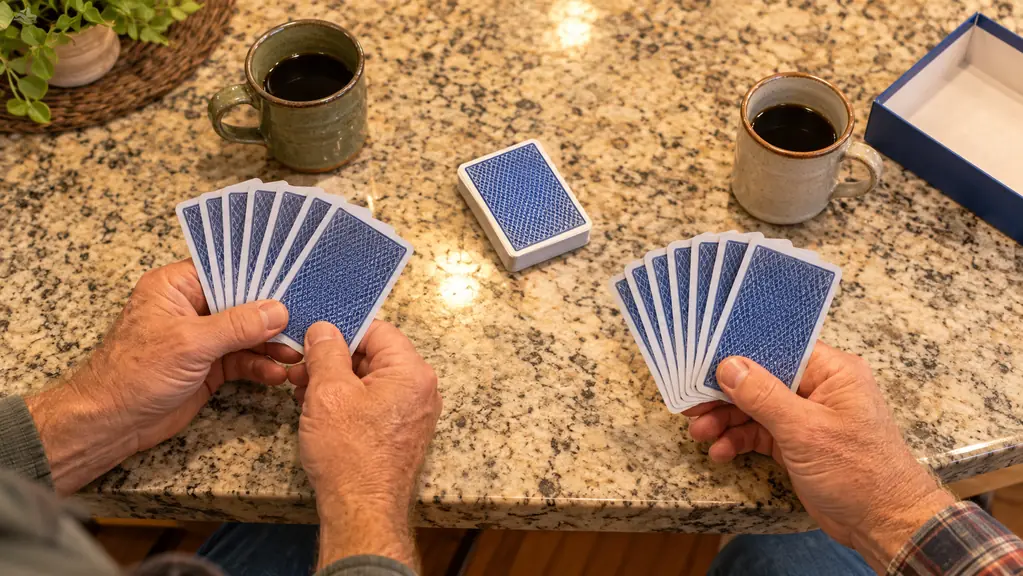
Short. That is the honest answer. Sessions run around half an hour, and because the rounds move quickly you feel the shape of the evening rather than watching a clock. We have played two in a row on a good night and stopped after one on a bad one. The good part is that stopping after one does not feel like failure. There is no three-hour campaign hanging over the table, and no board left out for a week because neither of you had the energy to put it away. That single detail is why this box comes out of the drawer and the others do not.
It also gives us something to talk about that is not the kids, the schedule, or the thing Marcus's dispatcher did on Tuesday. That sounds small. By the end of a long week it is not small. On more than one night we have finished a game and kept talking for another twenty minutes, because the game gave us a starting point that was not logistics. Our routine now is dinner, one round, then whatever we were going to do anyway. It has not turned us into people who light candles. It has turned a flat evening into an evening with a small event in the middle of it.
The Trick-Taking Part, Explained for People Who Do Not Play Card Games
Trick-taking is the old format where each player puts down one card and the higher card takes the pile. If you have ever played euchre or hearts, the rhythm will feel familiar. You do not need that background to learn it, but it helps. What makes this a game for two rather than a party game is that everything is built around exactly two people, which the listing states directly. Nobody is sitting out. Nobody is waiting for a fourth to arrive. That sounds like a small design note and it is actually the whole reason we can play it on a Friday with no planning.
With only two hands in play, every decision carries more weight. You are not tracking three other people and guessing who holds what. You are watching one person, and there is nowhere to hide. The listing describes the two-player design as balanced so that neither player gains an unfair advantage, and in our house that has held. Marcus still wins more nights than I do. I have won enough of them to keep suggesting we play, which is the test that actually matters. A game where one person wins every week stops getting suggested by week three.
There is a learning curve, and it is short. Two nights, maybe three, depending on how much card playing you have done before. After that you stop thinking about the rules and start thinking about the other player, which is the actual pleasure of the thing. That shift arrives faster here than it does in most games we have brought home. It is also why I would not judge it on night one, when you are both still reading the sheet and nobody is playing well.
The Box, the Table, and the Living Room Reality
Physical details matter more than reviews usually admit, and the Renegade Game Studios box is the reason this one survived in our house. It is small enough to live in the drawer of the end table beside the sectional instead of going up on the shelf with the games we mean to play someday. It weighs almost nothing. The cards are cardstock. Nothing about it is precious, which means I do not panic when our son walks past the island, and I do not need to clear the whole kitchen to set it up.
Setup and cleanup decide which games live and which games die in this house. If a box needs a fifteen-minute arrangement before the first turn, it gets played twice and then it migrates to the top shelf. This one comes out, gets played, goes back in the drawer. That is genuinely most of the review. Everything else is secondary to whether two tired people will actually pull it out at 8:40 on a Friday. Our living room is a sectional, a television, and a lamp, and this fits in it without rearranging anything.
Where It Frays
It is a two-player game. That is the biggest limitation and it is printed right on the listing. When our daughter wants in, someone has to sit out, and sitting out is not fun for anyone. We tried a three-person workaround exactly once and it fell apart inside ten minutes. If your household has three people who all want to be involved, this is the wrong box for that night. It is a game for the two of you, and it stays that way.
The theme is decorative more than transformative. The listing calls it a fairy tale theme, and the art is lovely, but you are not role-playing anything. You are playing cards. If one of you needs a story or a world to stay interested, this will feel dry by the third night. There is also no campaign and no progression system. What you learn carries over in your head, not on a score sheet, so nobody can point at a record and prove they are ahead.
And it is still a card game. If your partner groans at the sight of a deck, this will not convert them. It is not a party game, it is not a conversation deck, and it will not entertain a group of six. It is thirty minutes of quiet competition with one other person. For some couples that is exactly the point. For others it will land like homework, and no amount of pretty art fixes that. I would rather say so than have someone buy it and feel tricked.
What We Tried Before This
We tried a lot of things. Puzzle nights died because one person ends up doing the puzzle while the other watches. A cook-something-new night was great exactly once and then felt like a chore with extra dishes. We ordered a date night subscription box and it arrived with supplies we never opened, still bagged, still in the hall closet. We also tried a plain deck of cards, which is fine, except one of us has to suggest it and the other has to agree, and there is no structure pulling two tired people toward the table.
What Renegade Game Studios sells here is not magic. It is a small, well-made box with a defined end point, and that definition is the piece we were missing. Thirty minutes is short enough that Marcus will say yes at 8:40 at night and long enough that the evening feels like something rather than a gap between dinner and bed. If you have been circling the same problem in your house, that is the honest case for it.
What I Liked
- Sessions run around thirty minutes, so it fits a weeknight without swallowing the evening
- Small box lives in an end-table drawer instead of a closet shelf
- Rules learnable in one sitting for two adults, with no rulebook needed on night two
- Balanced two-player design, so the same person does not win every single week
- Rated ten and up, which meant our fifteen-year-old could step in when a friend canceled
Where It Falls Short
- Two players only, with no workable way to add a third
- Fairy tale theme is on the box more than in the play
- First two or three nights are a learning curve if trick-taking is new to you
- Will not win over a partner who simply does not like cards
We have played it most Friday nights for months. Setup is under two minutes, and that is the only reason it survived in a house with two kids and a 6:15 a.m. alarm.
Who This Is For
Couples who want a small, structured thing to do together at home once the kids are down, and who are fine with quiet competition instead of a big production. It suits people who already like cards, and it suits people who do not, as long as the person who does not is willing to lose the first two nights while learning. It suits a house like ours, where the living room is a sectional and a television and there is no spare room for a game table. If you want one box that earns its drawer space and gets used in the ten minutes before you both fall asleep, this is a reasonable bet.
Who Should Skip It
Skip it if you need something for three or more people, because it is built for exactly two and does not stretch. Skip it if the fairy tale theme is the draw, because the theme is on the box more than it is in the play. Skip it if one of you will not sit still for half an hour of cards, or if you are looking for conversation prompts and deep talks, because this is a game and not a deck of questions. And skip it if you want a campaign you build on week to week. There is nothing here to build. There is just a good thirty minutes, over and over, which turned out to be what we needed.
Thirty Minutes That Beat Another Night of Scrolling
Two players, one small box, and a defined end so you can stop after one round and still call it a date night.
Amazon Check Today's Price on Amazon →