
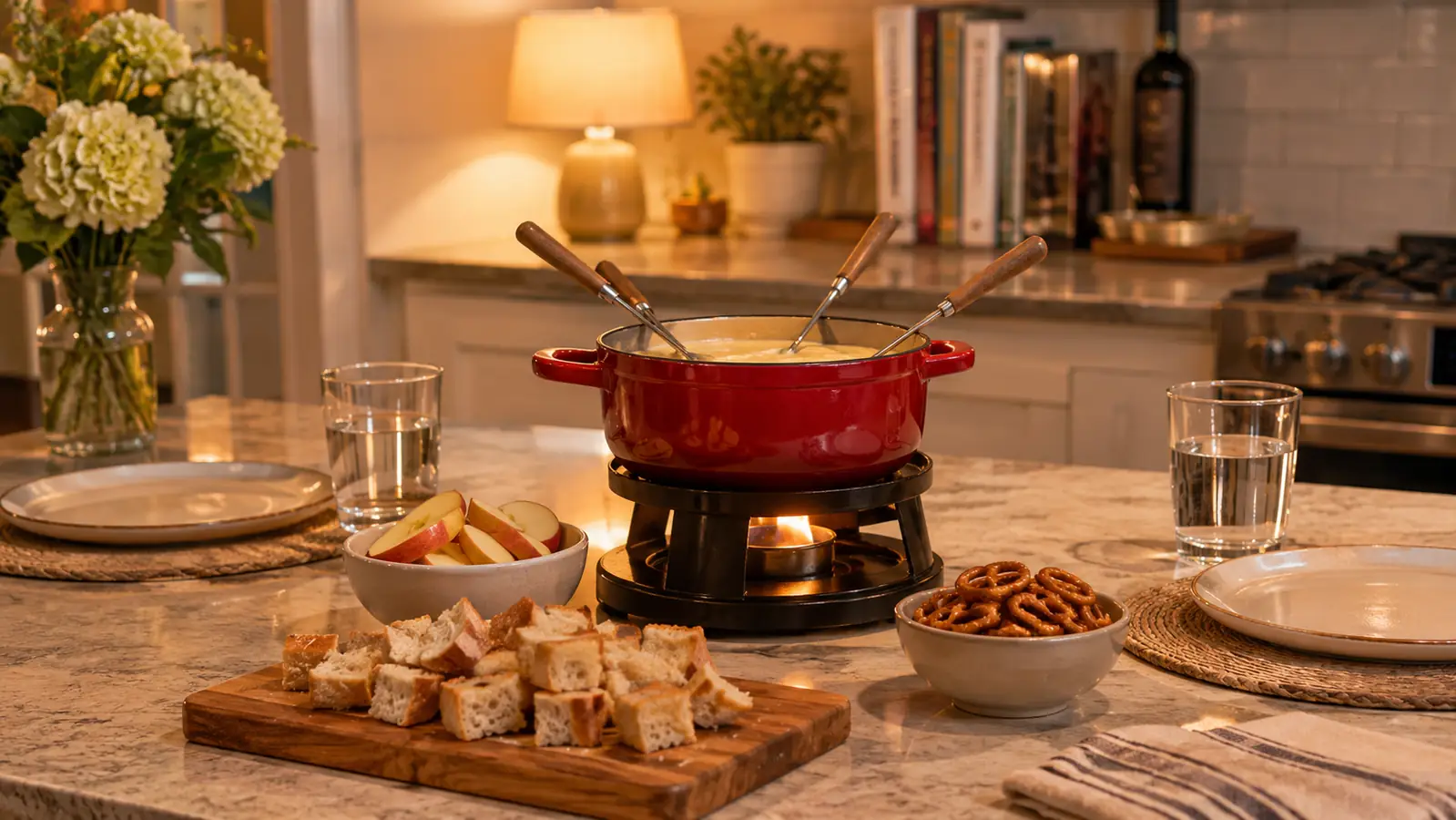
Marcus falls asleep on the couch at 9:30 most nights. He is up at 4:40 for HVAC service calls, so by the time Friday arrives he is running on fumes, and if I do not put something in front of him that keeps his hands busy, he is gone before the second episode starts. That is how we ended up with a fondue pot on our kitchen island on a Saturday in January, kids at my mother's, a bowl of cubed bread going stale on the counter, and two hours ahead of us with nothing on the schedule.
A cheese and chocolate fondue dinner sounds like more work than it is. It is not nothing, though. The first time I did it I melted the cheese too fast, the bread slid off the forks into the pot, and we ate standing up because I never thought about where the plates would go. The second time was better. By the fourth time the setup took twenty minutes and the evening took two hours. The pot did the melting. The Cuisinart 3-quart electric model is what we use, and the reason it works for us is boring: the adjustable temperature probe lets the cheese hold without scorching while we are still talking, and that is the whole trick.
The pot that holds a low, steady melt while you sit down
Adjustable temperature probe, 3-quart capacity, eight color-tipped forks and a fork ring. That is the entire setup.
Amazon Check Today's Price on Amazon →Step 1: Pick the night and clear the island
Friday sounds right and usually is not. Marcus comes home with his shoulders up around his ears and eats whatever is fastest, standing at the counter. Saturday is better. Get the kids settled in their rooms or send them to a grandparent, put the phones face down in the other room, and give yourself a clear hour before you start. Fondue is a slow meal, and slow meals do not work if one person is checking the clock.
Clearing the island matters more than it sounds. You need room for the pot in the middle, a plate and a small bowl at each setting, and somewhere to put the raw dipping pieces that is not the same plate as the cooked ones. I move the fruit bowl, the mail, the school papers, the laptop. All of it. If the counter is cluttered we end up eating off our knees in the living room and the whole thing falls apart.
One Saturday in January I skipped this part and paid for it. I started at 6:40, the kids were still up arguing over a tablet, the mail was in a pile by the sink, and I was grating cheese with one hand while moving a stack of school papers with the other. Marcus walked in, looked at the counter, and asked if we should do this another night. We did it anyway, but it was 45 minutes later and neither of us was in a good mood by the time the cheese finally melted. Now I clear the island at 5:30, before anyone is hungry, and the same evening starts completely differently.
Decide the dish plan before you sit down, too. One pot means you melt cheese, eat, then wipe the pot out and melt chocolate. That is two rounds of dishes at the end of the night, not one. Leave them. Wash the pot together in the morning. Honestly, that part is nice.
Step 2: Buy the dipping pieces before the day of
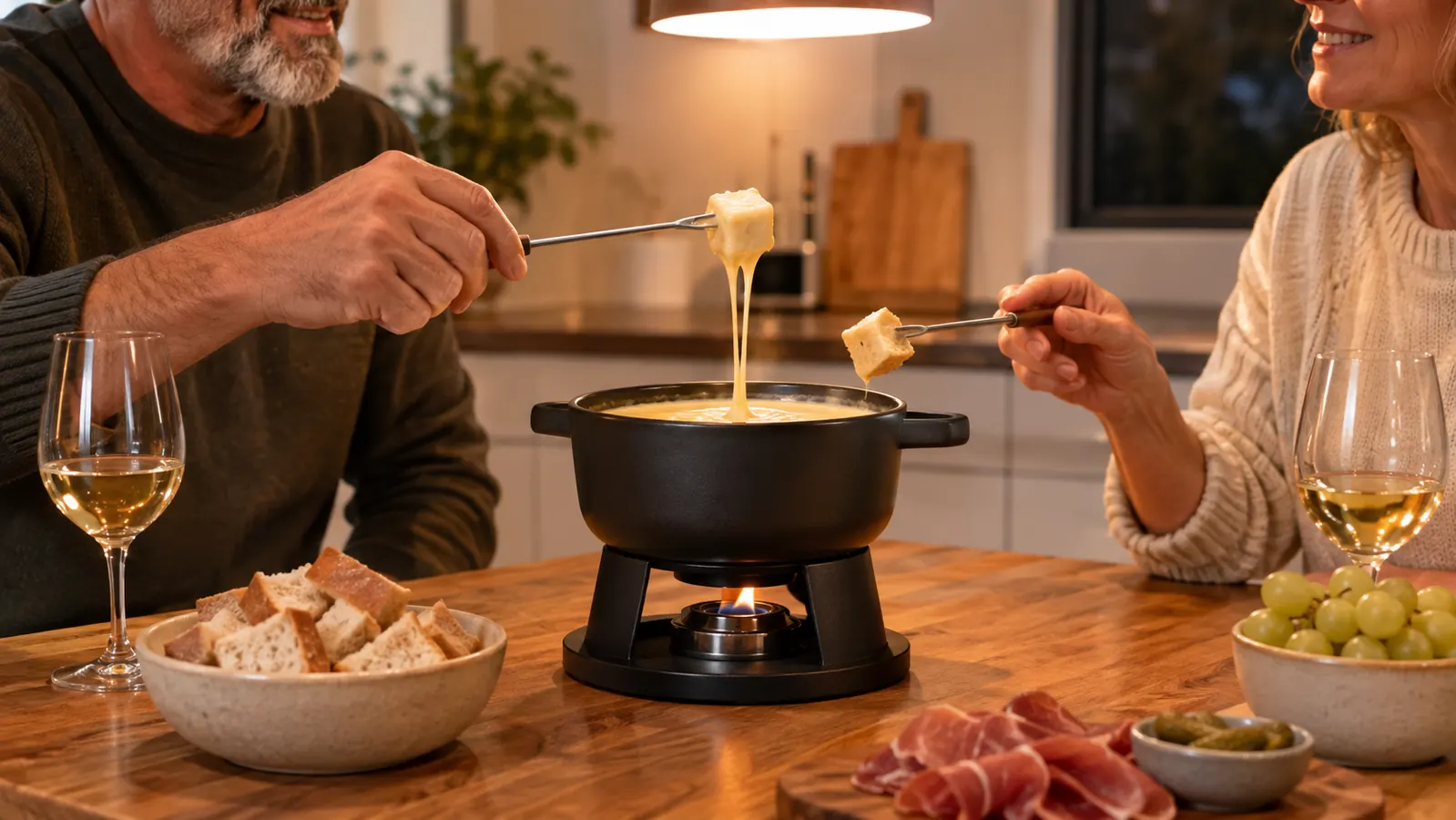
Two courses means two short grocery lists. For the cheese: a firm melting cheese, a baguette cut into cubes, something crunchy, and something tart like apple or pear slices. For the chocolate: good chocolate, a splash of cream, fruit, pound cake, pretzels, marshmallows. Nothing on either list is expensive or hard to find, which is half the appeal.
The bread detail is the one people get wrong. Fresh bread falls apart in the cheese. Cubed and left out for a few hours, or overnight in a bowl with a towel over it, it holds on the fork and gets a little chew to it. I cut mine the morning of and leave the bowl on the counter with a plate on top.
Here is what I actually bought the last time, so you have something to work from. One baguette, one firm wedge of melting cheese about the size of my fist, two apples, a bag of pretzel rods, a bag of marshmallows, a pint of strawberries, and a small pound cake from the day-old rack. That fed two people through two courses with bread left over, and the whole trip took eleven minutes because it is all in the same two aisles. I buy the cheese the day before and grate it the morning of, because grating cheese at 7 p.m. with a glass of wine in the other hand is how fingers get involved.
If you are shopping the day of, skip the pound cake and use whatever is already in the cupboard. Cookies work. So does a banana. Buy more dippers than you think you need, because two people will go through a whole baguette without noticing, and buy one thing each of you actually likes. The point is that both people are happy, not that the table looks like a magazine spread.
Step 3: Learn the probe before any cheese goes in
Before the cheese, put an inch of water in the pot and run the adjustable temperature probe up and down once so you know how it responds. You want to see what the low end looks like, because that is where you will spend the entire evening. The probe is the whole reason an electric pot beats a candle or a gel burner: you set it and the pot holds. With a flame you are guessing, and cheese that gets too hot turns into a stringy lump sitting in a puddle of grease. No amount of stirring brings it back.
While you have the water in, note how the Cuisinart comes apart. Unplug it, let it cool, pull the probe out, and the cord comes off with it. That means you can wash the pot properly instead of wiping around the electrical end and hoping. Do this once on a quiet afternoon so you are not learning it at nine o'clock with a bowl of grated cheese waiting.
Then dry the pot, put it back on the counter, and get everything within arm's reach. Grated cheese, cubed bread, sliced apple, plates. The melt is the easy part. Reaching for something across the kitchen while the cheese sits there is what turns a good evening into a small mess.
Step 4: Melt the cheese first, chocolate second
Cheese first. Grate it, toss it with a spoon of cornstarch, and put it in the pot with a splash of wine or milk over a low setting. Stir in one direction. When it is smooth, turn the probe down as low as it will hold the melt and start dipping. Do not walk away in the first five minutes. After that it will sit there happily while you eat, which is the entire reason this works as a date instead of a cooking project.
The first cheese I made was a disaster and I know exactly why. I had the probe turned all the way up because I wanted it to melt faster, then I dumped in a whole bowl of cold grated cheese at once. Within two minutes it was a rubbery mass floating in liquid fat, and stirring only made it worse. I threw it out and started over with the probe at the low end, adding the cheese in three handfuls and stirring between each one. That second batch took four minutes longer and came out smooth. Slower is faster here, which is annoying advice and also true.
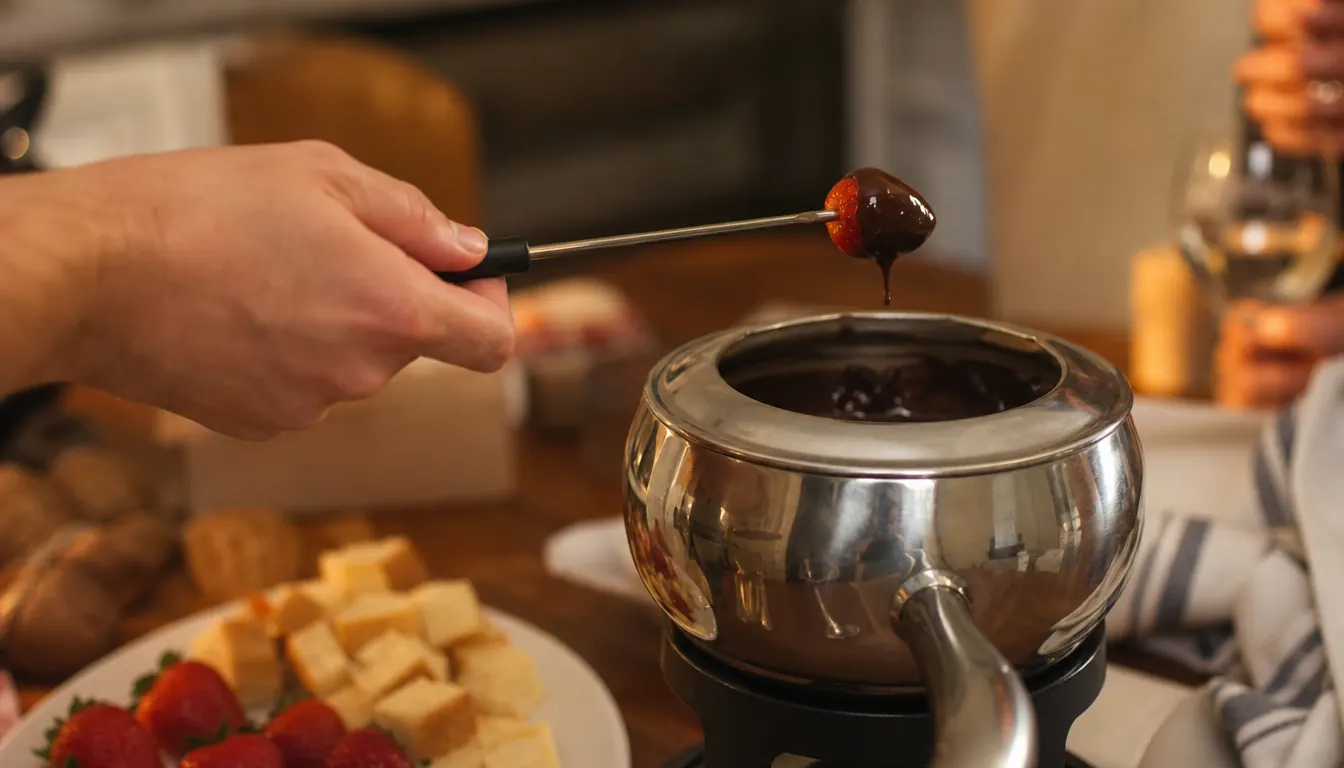
When the cheese is gone, unplug the pot, let it cool enough to handle with a towel, and wipe it out with a paper towel. Then start the chocolate. Chocolate is more forgiving on the melt and less forgiving on heat. Keep it low, stir, and add a little cream if it tightens up. If a drop of water gets in, it will seize, so dry your fruit and dry your fingers.
Eat the cheese course sitting down. Then clear the plates, refill the water, and let the chocolate be the second half of the evening. That rhythm is what makes it feel like a dinner instead of a snack you ate over the sink.
Step 5: Set the table so nobody reaches across the pot
The set comes with eight extra-long, color-tipped forks and a fork ring, and the ring is the underrated piece. It holds the forks upright around the pot so nobody's handle is sitting in somebody else's cheese, and it keeps the tips off the counter between dips. Two people do not need eight forks, but the ring earns its space.
Give each person a plate, a small bowl for the dippers they have claimed as theirs, and a napkin. Sit next to each other or across a corner, not across the full length of the island. Fondue is a close-quarters meal and the Cuisinart is only seven inches wide, so it does not need acreage. It needs the two of you within reach.
One more thing: decide in advance who is getting up. Nobody wants to be the person refilling the bread while the other one is mid-dip. I do bread. Marcus does the pot. We settled that after an argument about a pretzel, which is the most married sentence I have ever written.
What Else Helps
Music you both already know, kept low. A pitcher of ice water. Candles if you have them, and if you do not, turn off the overhead light and turn on the lamp in the next room. The kitchen does not need to look like a restaurant. It needs to not look like Wednesday.
One practical thing I learned the hard way: put the pot on a trivet or a folded towel if your island is butcher block or quartz, and keep it at least a foot back from the edge. The outside of the pot gets warm enough that you do not want a forearm against it, and the stainless does not cool down the second you unplug it. The first time we did this I set it right at the corner of the island and spent the whole evening watching it out of the corner of my eye instead of talking to my husband.
The bigger thing is expectations. This is not a fancy night. It is a slightly slower version of a normal night with better food and no television. Some weeks it lands and we sit there for two hours working through a baguette and talking about people we went to high school with. Some weeks Marcus's back is bad and we dip two strawberries and go to bed early. That is still a win. The Cuisinart does not manufacture the conversation. It just keeps the cheese from turning while we have one.
Keep a roll of paper towels on the table, use the pot somewhere that can take a drip, and plan on the clean-up being a two-person job in the morning. I have never once regretted any of that. I have regretted trying to rush the chocolate, which is how you end up scraping a burnt layer off the bottom and pretending it did not happen.
The pot will hold a low, steady melt for two hours. What it cannot do is sit across from your husband and ask him about his day. That part is still on you, and it takes about four minutes.
Twenty minutes of setup, two hours of evening
3-quart capacity, adjustable temperature probe, eight color-tipped forks and a fork ring. The rest is bread and chocolate, and you already know how to buy those.
Amazon Check Today's Price on Amazon →