

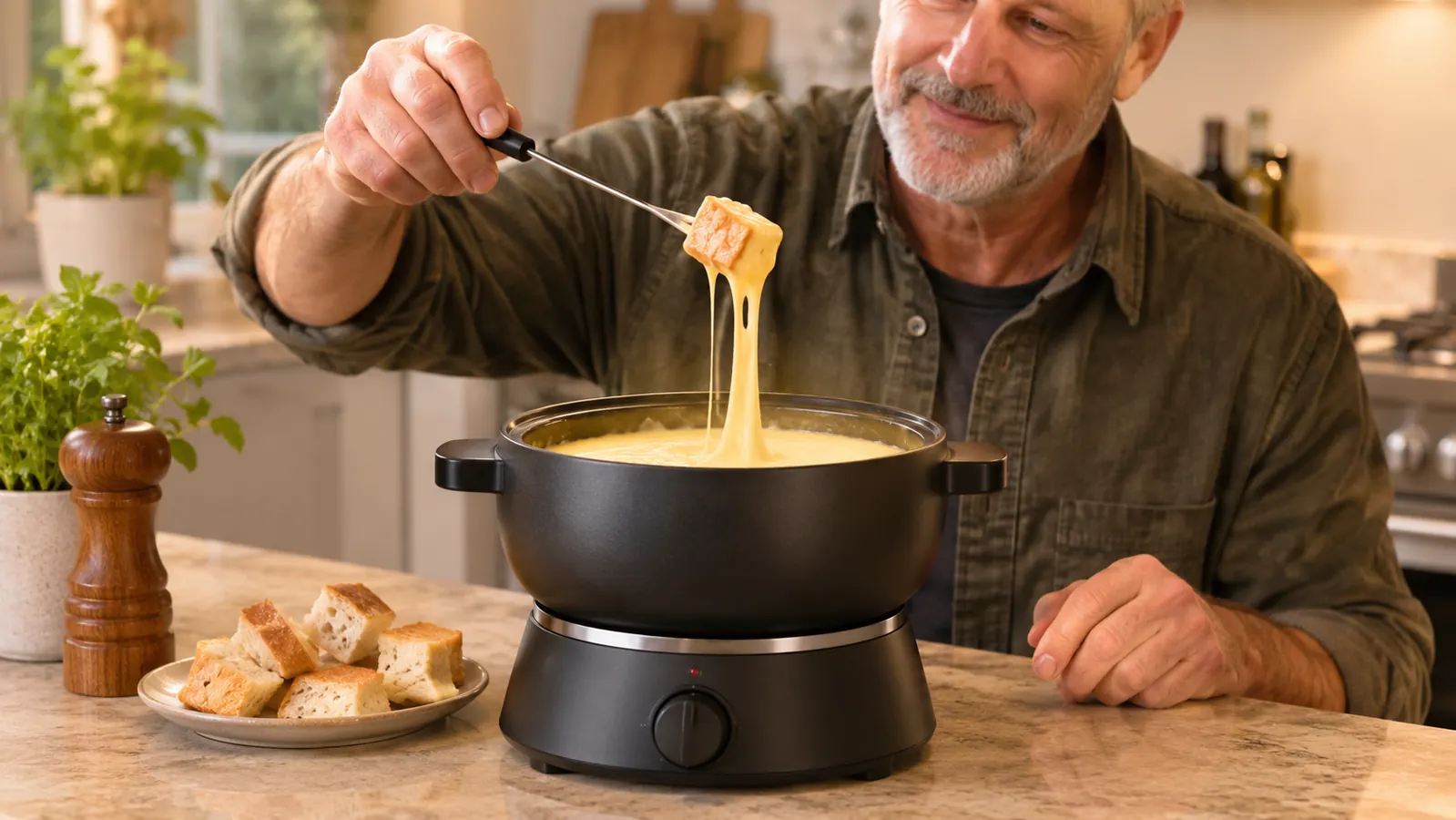
Short answer: if date night at your house means a full pot of cheese, a plate of bread and apples, and then a second round of chocolate an hour later, the Cuisinart 3-Quart Electric Fondue Pot and Set is the one I would buy again. If you want one small pot of chocolate for two people, set out and put away inside twenty minutes, the Nostalgia set does that job and takes up less room doing it. I ran both through the same kitchen, the same island, and two ordinary Friday nights, and the difference between them was not really about which one melted cheese better. It was about how much of the evening the pot asked me to spend on the pot.
We have been married eighteen years, and Friday night at our house is not what a magazine would photograph. Marcus works HVAC service and is out the door before five, so if nothing is planned he is horizontal on the sectional by 9:30. The kids are fifteen and eleven and mostly disappear to their rooms after dinner. That leaves a two hour window and a choice: watch something neither of us will remember, or stand at the kitchen island doing something with our hands that keeps us talking. Fondue won that argument about a year ago and it has not lost it yet.
| Cuisinart 3-Quart Set | Nostalgia Fondue Set | |
|---|---|---|
| Capacity | 3 quarts, four people dip without a refill | Sized for two, no second course without a wash |
| Heat control | Adjustable temperature probe, oil holds true frying heat | Simpler control with looser steps, needed watching and stirring |
| Forks in the box | Eight extra-long, color-tipped forks plus a fork ring | Four shorter forks |
| Cleaning | Probe and cord pull out, pot goes in the sink | Cord sits at the base, so I wiped it instead of washing it |
| Counter footprint | 10.5 by 7 by 6.12 inches, a real piece of counter | Smaller body, fits beside the toaster |
| Storage between dates | Bottom shelf, two hands to lift | Fits on a shelf above the fridge |
| Best for | Cheese, broth or oil in one evening, seconds included | One pot of chocolate for two, put away fast |
Where Cuisinart Wins
Capacity is the first honest difference. Three quarts means four people can dip at once without the level dropping to a sad scrape at the bottom, and it means a second course does not require a second pot. In February we had another couple at the island with us, four sets of forks going at once, and the cheese held up for a solid ninety minutes before anyone had to think about adding more. When our fifteen year old wandered out later looking for dessert, there was still room to melt a full bag of chocolate chips and keep the evening going. With a smaller pot, that same night becomes two loads of chocolate with a wash in between, and the washing is the part that kills the mood.
The temperature probe is the piece that earns its keep. You set it and the pot holds that heat, which matters most when you are frying rather than melting. The listing says oil reaches true frying temperature without guesswork, and after a few tries I believe it. The first time I did oil I kept waiting for the moment where I would have to hover and adjust, and it never came. Cubes of bread and small pieces of steak went in and came out crisp and golden instead of spongy with oil. On a looser control you spend the whole course nudging the setting, and you burn the first batch just to find out where the line is. I lost a batch of bread that way on the smaller pot, which is how I learned the difference the hard way.
Eight extra-long forks arrive with a ring to hold them, and that small piece of hardware does more for the evening than it sounds like it would. Everyone claims a color, nobody reaches across the pot, and nobody is stuck hand washing a fork between courses. Four forks means a couple is fine and a family of four is passing one back and forth all night. The length matters too. Long forks keep hands away from hot oil, which is the difference between a good story and a first aid kit. The ring itself is a small thing that keeps the island from turning into a pile of used forks on a napkin.
The build is plainer than the product photos suggest, which I mean as a compliment. Stainless steel outside, a non-stick interior, 2.6 kg on the kitchen scale, heavy enough that it does not skate across the counter when someone leans on the rim with a fork and light enough to carry from the pantry to the island one handed while the other hand holds a plate. It measures 10.5 inches deep by 7 inches wide by 6.12 inches tall. Cuisinart covers it with a limited three year warranty. I have never had to use that warranty, and I like knowing it is there the way I like knowing where the flashlight is when the power goes out.
Cleaning is the least romantic consideration and the one that decides whether a pot gets used twice a year or twice a month. After you switch it off, unplug it and let it cool, the probe and cord pull out and the pot goes in the sink. The interior is non-stick, so cheese releases with warm water and a soft sponge instead of an overnight soak, and the stainless exterior wipes down. I have used pots where the cord is fixed to the body and you end up cleaning around an electrical component with a damp cloth. That is exactly the friction that ends a ritual.
Eight color-tipped forks in a ring, a probe that pulls out, and three quarts. None of that sounds romantic, and all of it is why we still do this on a Friday.
Where Nostalgia Wins
Counter space is where the Cuisinart loses, and I am not going to pretend otherwise. Those dimensions are real estate. On an island that also holds a fruit bowl and whatever the mail brought in, it does not tuck into a corner the way a smaller pot does, and you will notice it every single time you set it down. Our kitchen is not tiny and it still felt like something had moved in. If yours is tighter than ours, measure the spot where you plan to put it before you decide.
The smaller pot has one genuine advantage that has nothing to do with size. A small volume of chocolate comes up to temperature quickly, so you are not standing there waiting for a big pot to get there while the conversation runs out. When I set the small one out at ten at night with a bag of chocolate chips and a bowl of strawberries, we were dipping inside a few minutes. There is less to wash and less to think about, and the whole thing feels like a snack rather than a production. If your at home dates start late and run ninety minutes, that speed is worth something real.
Storage is the third place the smaller set quietly wins. The one I borrowed fit on a shelf above the fridge, which is where small appliances go when they have earned a spot. The Cuisinart took the bottom shelf of a pantry cabinet and both hands to lift. That sounds trivial until you are the person who has to haul it out at eight on a Friday and put it back at ten, and in most houses one of you is always that person. Anything that needs two hands and a cleared shelf gets used less often. That is not a knock on the pot, it is just how cabinets work.
And the small pot is honest about what it is. Nobody at that table expects a cheese course, so nobody is disappointed when it does not deliver one. It is a chocolate pot, it does chocolate well, and it goes back on the shelf above the fridge without a discussion. There is a certain peace in owning a thing that does one job and does not pretend otherwise.
The size that carries a whole evening, not just one course
Three quarts, an adjustable temperature probe, and eight color-tipped forks in a ring. This is the pot that stayed on our island.
Amazon Check Today's Price on Amazon →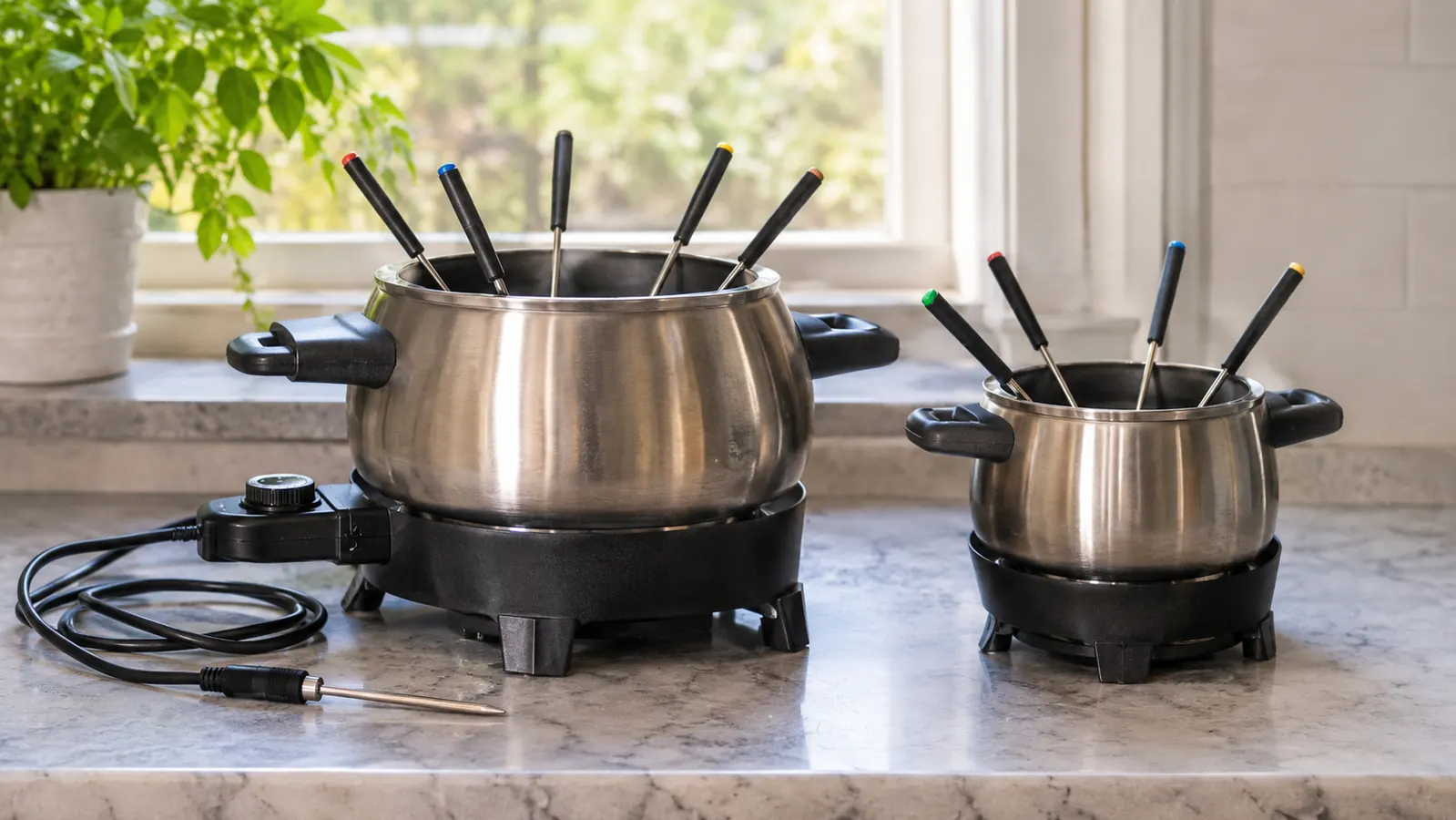
What the Setup Is Actually Like on a Friday Night
Here is the real sequence in our house. Marcus gets home, eats something standing up because he has been in a truck since six, and we put the kids on dishes. I cube a loaf of bread, cut two apples, and open the cheese. The pot goes on the island, the probe goes in, I set it low for melting, and we are dipping within twenty minutes of deciding to do it. That timeline is the entire reason fondue beat every other at home date idea we tried. No reservation, no sitter, no driving, no deciding what to wear, and no version of the evening that depends on a restaurant having room for us at seven.
The second course is where the bigger pot pays for its counter space. Around nine I lift the pot off, wipe it out while it is still warm, and we go again with chocolate and strawberries. Same forks, same ring, same evening. With the smaller pot we did the cheese, washed, then did the chocolate, and the ten minutes in the middle was ten minutes of us standing at the sink instead of sitting at the island. Ten minutes does not sound like much until you have watched a conversation cool off while one of you scrapes at melted cheese.
One Saturday in February the kids were at my mother's for the night, which almost never happens, and we did the full thing: cheese at seven, oil for steak and mushrooms at eight, chocolate at nine thirty. Three courses, one pot, one wash at the end. That night is the argument for the Cuisinart in a single sentence. The oil course in the middle would not have happened with the small pot at all, because I am not standing over a looser control at eight in the evening frying cubes of beef and hoping. The probe held, the steak came out the way it should, and Marcus said it was better than the place we go for our anniversary, which I am choosing to believe.
Now the honest part. Neither pot made our marriage better and I would not tell you it did. What the Cuisinart did was remove four small frictions that used to sit between the idea and the actual evening: the waiting, the burning, the fork shortage, the scrubbing. Take those out and the two of you are left with a plate of bread, a pot of melted cheese, and an hour and a half where nobody is looking at a phone. The pot just makes that hour easier to reach. The rest of it is the two of you deciding to sit down.
Who Should Buy Which
Buy the Cuisinart if your version of the evening has two courses and more than two people drifting through it. If a teenager is going to appear at nine looking for chocolate, if you want to fry steak cubes in oil and not babysit the heat, and if you would rather wash one pot at the end than three loads in the middle, the capacity and the probe are worth the counter space. This is the one for a house that intends to do this regularly, and the three year warranty backs that intention.
Buy the Nostalgia if you are two people, chocolate is the whole event, and your kitchen counter is already crowded. It is smaller, it stores easily, and it comes up to heat fast for a small volume. It will not hold a four person cheese course and it will not fry, but if the plan is strawberries and chocolate at nine o'clock after the kids are down, it does exactly that and gets out of the way. There is nothing wrong with owning a pot that is only good at one thing when that one thing is the thing you actually do.
The trap to avoid is buying the big one because it sounds more serious and then never dragging it out. I know two couples who own pots like this and both of them keep theirs in the basement. If the hauling and the washing is going to stop you, buy the smaller one and do chocolate on Fridays. A small pot used weekly beats a big pot used twice a year, and that math is more useful than any spec sheet.
And if you read this far thinking fondue sounds like a lot of dishes, believe yourself. No appliance fixes that. What I would say is that the dishes are the price of the two hours, and the two hours are the point. Pick the pot that matches the evening you actually have, not the one you saw in a picture.
Two hours, one pot, and a Friday you will still be talking about on Sunday
You do not need a bigger kitchen or a better plan. You need something that comes out of the cabinet without a fight and rewards the effort. For us, that is the Cuisinart 3-quart set.
Amazon See the Cuisinart Set on Amazon →