

Friday night at our house used to go like this. I would ask Marcus what he wanted to do, he would say he did not care, and by 9:30 he would be asleep on the sectional with a home improvement show running. He is up at 4:40 most mornings for HVAC service calls, so I am not blaming him. But eighteen years in, sitting next to a sleeping man while I scroll my phone is not a date night. It is just two people in the same room, not talking.
That is how the Cuisinart 3-Quart Electric Fondue Pot and Set ended up on our kitchen island in January. I bought it assuming we would use it twice and then it would live in the back of the pantry next to the bread machine. Instead it has run most weekends since, plus a handful of weeknights when the kids were at my mother's. I have made cheese fondue, chocolate fondue, and hot oil fondue in it. I have burned exactly one batch of chocolate, which was my fault and not the pot's.
The Quick Verdict
Easy to run, easy to clean, and steady enough that cheese and chocolate do not scorch on you. The 3-quart bowl is more pot than two people need, and the cord is short enough that you need to plan where it sits.
Amazon Check Today's Price →The appliance that turned a vague Friday plan into an actual evening
Twenty-some uses in and it still sits on the island instead of the pantry. Check the current price and see the full listing for yourself.
Amazon Check Today's Price on Amazon →How I've Used It
The first thing I made was a cheese fondue on a Saturday in January, mostly because it was ten degrees outside and I wanted an excuse to open a bottle of wine and stand in the kitchen instead of sitting down. I grated a mix of Gruyere and sharp cheddar, tossed it with cornstarch, and let the pot do the melting. It came together in about twelve minutes with nothing scorching on the bottom, which genuinely surprised me. I have seized cheese in a saucepan more times than I can count.
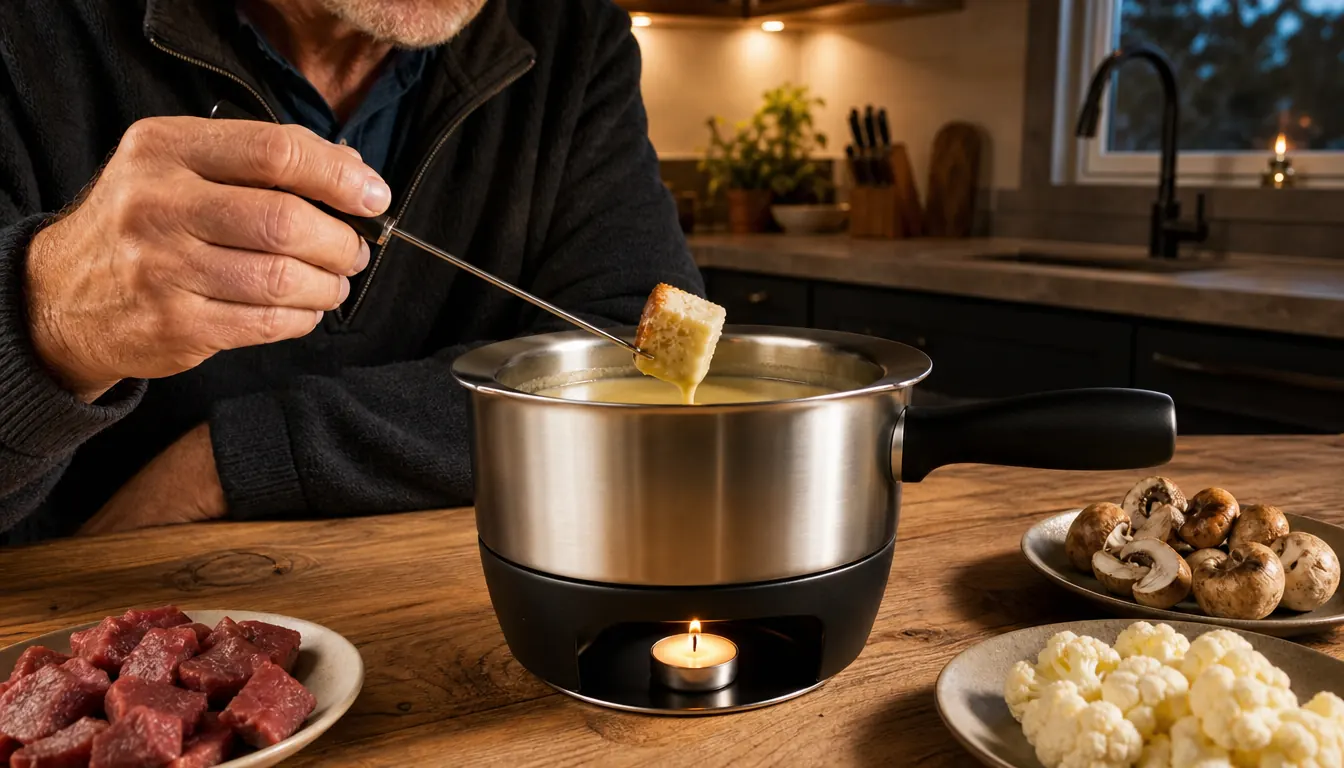
Since then I have settled into a rotation. Cheese on a cold Friday. Chocolate on a Sunday when the kids are actually home and want in on it. Hot oil maybe once a month, because oil is a bigger production and I am not doing that on a Tuesday. The oil night was the one I was most skeptical about. The listing says the adjustable temperature probe holds oil at true frying temperature without the guesswork, and after watching a cube of bread brown in about a minute at the setting I picked, I believe it. We did sirloin cubes, shrimp, mushrooms, and cauliflower florets. The cauliflower took the longest and was worth every second of the wait.
The February night my daughter asked if a friend could stay for dinner was the first time the pot pulled a real shift. I had planned cheese for two and suddenly needed to feed three teenagers and an eleven-year-old who eats like a linebacker. I cubed two more loaves of bread, added a bowl of apple slices and a pile of steamed broccoli, and moved the whole operation to the end of the island near the outlet. Nobody sat down. Everybody stood around eating for forty minutes, and the cheese held the same consistency from the first dip to the last. That is the thing I keep coming back to. It does not need babysitting to hold a temperature, only a stir now and then.
Twenty-some uses in, nothing has warped. The finish has not bubbled or flaked. The pot still sits flat on the counter with no wobble, and the forks have not bent even though my fifteen-year-old has tested them. That is more than I can say for the sandwich press I bought the same year.
The Temperature Probe Does the Actual Work
Most electric fondue pots I looked at before this one had a dial with numbers and no explanation of what the numbers meant for what you were cooking. The Cuisinart has a temperature probe that goes down into the pot, and the instruction book gives you starting settings for cheese, chocolate, and oil. That sounds like a small detail. It is the whole reason this thing works.
Cheese is the fussiest of the three. Too hot and the proteins tighten up and you end up with a grainy, stringy mess that tastes fine and looks terrible. With the probe set where the book says, our cheese stayed smooth for the full hour we picked at it, and I only had to give it a stir a couple of times. Chocolate is even fussier. I did ruin one batch by walking away with the heat too high while I answered a text from my daughter about a ride home. That was me, not the pot. The second batch, with me standing there, came out glossy.
The oil night taught me the most about the probe. I filled the pot maybe two inches deep, set the probe where the book suggested, and dropped in a cube of bread to test it. It browned in about a minute, which is roughly what a pan of oil on the stove does when it is properly hot, and it did not sink and sit there greasy the way bread does in oil that is not hot enough. I have had that happen at a friend's house with a stovetop pot, and the sirloin that came out of it was a sad, oily thing. Here the sirloin had a crust in under two minutes and the shrimp took about one.
One thing the book does not tell you: the settings are a starting point, not gospel. My first cheese night needed a small adjustment because my mix was heavier on cheddar than the recipe assumed, and a cold kitchen changes things too. Expect one or two rounds of dialing it in and then you will know your own numbers.
The probe pulls out completely, and the cord comes out with it. That one design decision is the reason this pot gets washed and reused instead of sitting in the cabinet growing a reputation. Submerging an appliance with a fixed cord is a nightmare, and I have owned enough of those to know.
What 3 Quarts Means When There Are Only Two of You
Three quarts is a lot of fondue. Filled to a sensible working level for two people, we use maybe a third of the capacity and the rest of the bowl stays empty. The upside is that the sides are tall enough that nothing spits over the rim when oil is going, and melted cheese does not climb the walls and crust up. The downside is that you are paying for capacity you may not use on a normal Friday.
The pot measures 10.5 inches deep, 7 inches wide, and 6.12 inches tall, and it weighs 2.6 kg, so it takes a real footprint on the counter. Our island has the room. If yours does not, measure before you order, because this is not a small appliance you can tuck beside the toaster. What you get for that footprint is range. When the kids join us, or when my sister and her husband come over, the same pot feeds four without anybody feeling rationed. We have done six around it using all eight forks, and the only casualty was the bread basket, which had to move to the counter.
Eight Forks and the Ring That Keeps Them Straight
It comes with eight extra-long forks with color-tipped ends, plus a fork ring that holds them upright between dips. The ring is the part I did not expect to care about. Without it, eight forks end up lying across the rim and sliding into the pot, and you spend the evening fishing.
The extra length matters more than I thought it would. Standard fondue forks are short enough that your knuckles get close to the heat, and with hot oil that is a real concern. These keep your hand back far enough that I never once felt like I was about to burn myself. The colored tips mean everyone knows which fork is theirs, which sounds like a small courtesy until you have four people dipping into the same pot and someone starts accusing someone else of double dipping.
The ring also solves the placement problem. With the pot in the middle of the island, the forks stand up like a small fence and nobody has to reach across a hot rim to get at it. On cheese nights I put the bread board on one side and the vegetable plate on the other, and everyone works in a loop. My son, who is eleven and treats most family dinners like a punishment, has requested fondue four times since January. I am not going to pretend that is because of the forks. But the forks are why nobody is fishing a dropped one out of the cheese.

Cleaning Takes Four Minutes, Which Is the Real Test
After it cools and you unplug it, the probe and cord come out and the pot becomes a normal hand wash job. Cheese needs a short soak. Oil needs a wipe out with a paper towel before the soap. Four minutes, maybe five. Compare that to the cast iron fondue set over a fuel canister that I used exactly twice in my twenties and gave away to a coworker. The cleanup is what decides whether an appliance gets used or gets stored, and this one is on the right side of that line.
The first time I cleaned it after an oil night I expected the worst, because I have scrubbed a fryer basket before and lost an evening to it. Instead I let it cool on the counter while we finished the wine, wiped the inside with three paper towels, and the oil came out with the towels rather than going anywhere near the sink. Then a soak in hot water with a drop of dish soap and a soft sponge. I did learn not to use anything abrasive on the non-stick. My instinct with a stuck bit of cheese is a scrubby pad, and that instinct is wrong here. A plain sponge and a little patience does it.
The inside has a non-stick finish, which I was neutral about until I had to clean dried cheese out of it. Now I am in favor. I wipe the outside down with a damp cloth and it looks like the day I unboxed it. Cuisinart backs it with a limited 3 year warranty, which I have not needed to use, but it is nice to know it is there for a pot that gets this much counter time.
Where It Falls Short
The cord is short. I had to move the pot to the end of the island nearest an outlet, which put it slightly off center from where we sit. Not a dealbreaker, but know before you buy that you cannot stretch it across a kitchen, and if your only free outlet is behind the coffee maker, you will be rearranging things.
It is also not a set it and forget it appliance. You are standing there while it runs, stirring, dipping, adjusting. That is the entire point of fondue, so I do not count it as a flaw exactly, but if you were picturing yourself loading it up and sitting down on the couch, you will be disappointed. And the capacity point cuts both ways. Three quarts is more pot than a two-person household needs, so a chunk of what you are buying is headroom for a crowd you may only host a few times a year.
What I Liked
- The adjustable temperature probe holds cheese and chocolate steady without scorching
- Probe and cord both pull out, so the pot actually gets washed and reused
- Eight extra-long forks with colored tips, plus a ring that keeps them upright
- 3-quart bowl feeds four to six without anyone feeling rationed
- Held up through twenty-some uses with no warping, flaking, or wobble
- Limited 3 year warranty
Where It Falls Short
- Short cord limits where you can set it, so you need an outlet close by
- 3 quarts is more capacity than a two-person household uses on a normal night
- You have to stay with it while it runs
- Oil nights are a bigger cleanup than cheese nights
- Takes up real counter space at 10.5 by 7 by 6.12 inches and 2.6 kg
The probe pulls out completely, and the cord comes out with it. That one design decision is the reason this pot gets washed and reused instead of sitting in the cabinet.
Who This Is For
This is for couples who want an evening at home that is not a screen, and who are willing to stand in the kitchen for an hour to get it. Fondue forces the two of you into the same three feet of counter space with something to do with your hands, which turns out to matter more than I expected. On our fondue Fridays, Marcus is awake past ten. That has not happened in years.
There is a practical case for it beyond the romance angle. It is the easiest way I have found to make a Friday feel different without leaving the house, hiring a sitter, or making a reservation I will want to cancel by Thursday afternoon. Setup is ten minutes, eating is an hour, and cleanup is four.
It is also for families with teenagers who will absolutely join in if melted cheese is on the table, and for people who host small groups and want something that looks like an event without a three-hour cooking project. If you have an outlet near your island or counter and you like the idea of a dinner that is mostly assembly and dipping, the Cuisinart set fits that shape of evening well.
Who Should Skip It
Skip it if you want to load something up and walk away. Skip it if your kitchen has no outlet within reach of where you would actually sit, because the short cord will fight you every time. Skip it if you are cooking for one, since three quarts for a single person is a lot of pot and a lot of leftover melted cheese, which is a problem I did not know was a problem until February.
And skip it if what you actually want is the old fashioned cast iron pot over a flame. That is a different experience, and a good one, just a slower and fussier one. This Cuisinart is the version you will actually use on a Friday after a full work week, which for us was the entire question.
Twenty-some Friday nights later, it is still on the counter
Eight forks, a probe that pulls out for real washing, and a 3-quart bowl that handles a crowd or a quiet night for two. See the current price and the full listing.
Amazon Check Today's Price on Amazon →