
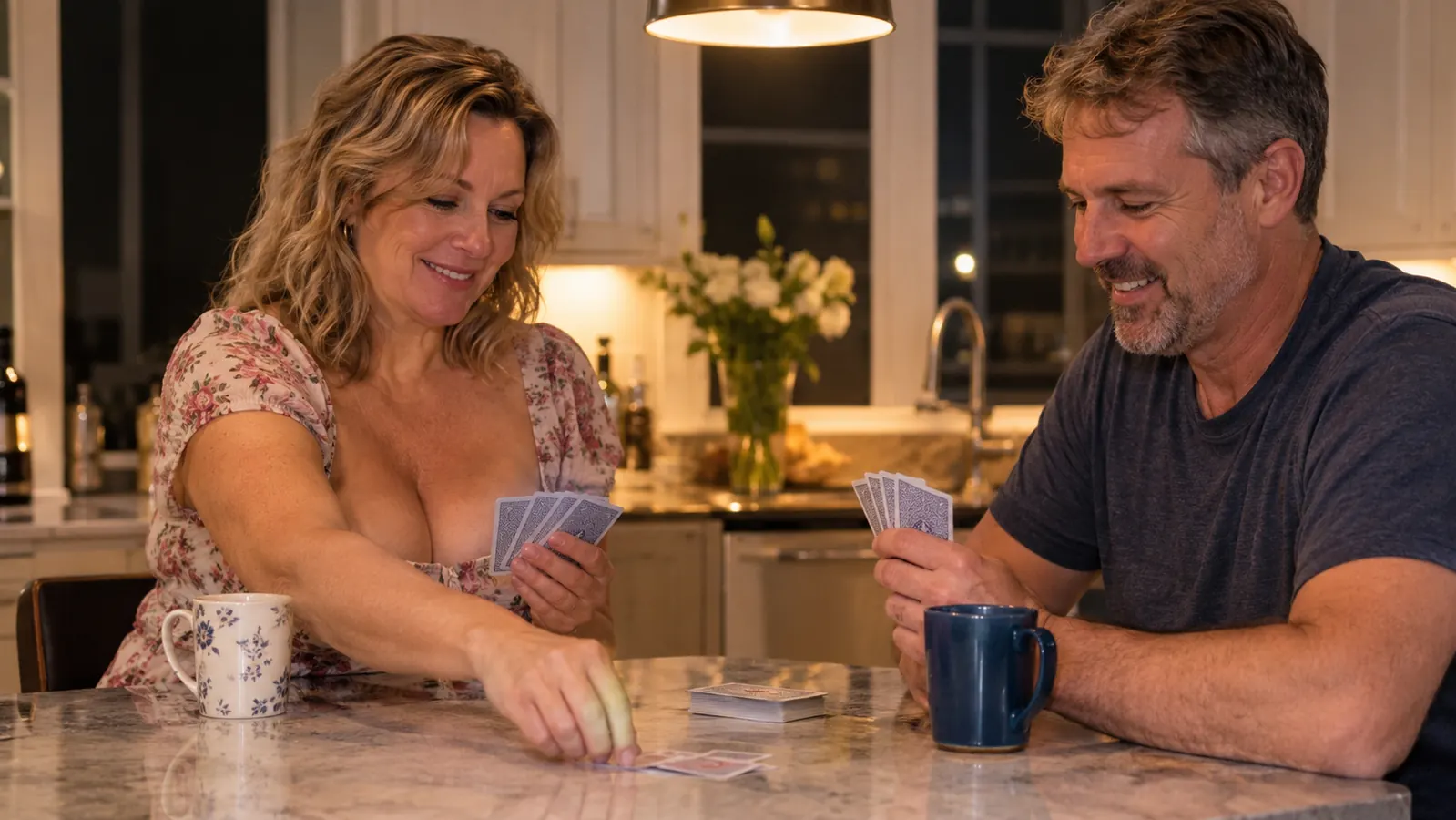
The Fox in the Forest is the first two-player card game in years that my husband Marcus has asked to play a second time. He runs HVAC service calls, his alarm goes off before five, and by 9:30 most nights he is flat on the sectional with his phone glowing over his face. That is the bar anything has to clear in our house: it has to be more interesting than a tired man and a screen. This small box from Renegade Game Studios clears it on most Friday nights, and I want to tell you about the parts the product page leaves out.
So this is an honest review, from a 44-year-old school office manager in a three-bedroom house outside Columbus. We have played it often enough to be past the novelty and into the habits. Some of those habits are good. One of them is me sighing at the kitchen island and dealing again. Both belong in a review, and the second one is the reason this is not a five-star write-up.
The Quick Verdict
A tense little trick-taking game that asks two tired people to pay attention to each other for half an hour. Real decisions, a ten minute teach, and a box that fits in a coat pocket. It also runs luckier than its reputation suggests.
Amazon Check Today's Price →Half an hour, two people, and no phone face up on the table
This is the box that lives in the drawer next to our coffee maker and comes out most Fridays. If your version of date night is two tired adults and something to do with their hands, it earns the space.
Amazon Check Today's Price on Amazon →How We Actually Play It
Friday night, both kids in their rooms, dishes still in the sink, and the box from Renegade Game Studios comes out of the drawer. Setup takes under a minute because there is nothing to set up. You shuffle, you deal, you play. That sounds like faint praise and it is not. Half the games in our house lose the whole evening to a rulebook and a hunt for a missing piece. This one loses the evening to the playing.
The rules teach in about ten minutes. Marcus reads a rulebook the way he reads a service manual, which is to say with a pen in his hand, and even he put the pen down after a couple of pages. One of you leads a card, the other follows suit, and the higher card takes the trick. The wrinkle is the line of text on some of the cards, which bends the rule for that trick or lets you do something you would not otherwise be allowed to do. Two rounds in, you stop reading the cards and start reading the person across from you, and that is the moment the game actually begins.
The listed playing time is 30 minutes and that number holds up for us. A round moves fast. If the game has you, you finish one and deal another. If it has not grabbed you that night, you are still not stuck at eleven o'clock explaining a rule to somebody who wants to go to bed. That matters more in my forties than it did in my twenties.
Our first game took longer than 30 minutes because we kept stopping to re-read cards. It was not a great advertisement for the game. The second game took maybe twenty minutes, and by the fourth we were dealing again before the mugs were empty. That curve is worth knowing about, because the first night is the one that decides whether the box goes back in the drawer for a year.
The Luck Question, Answered Honestly
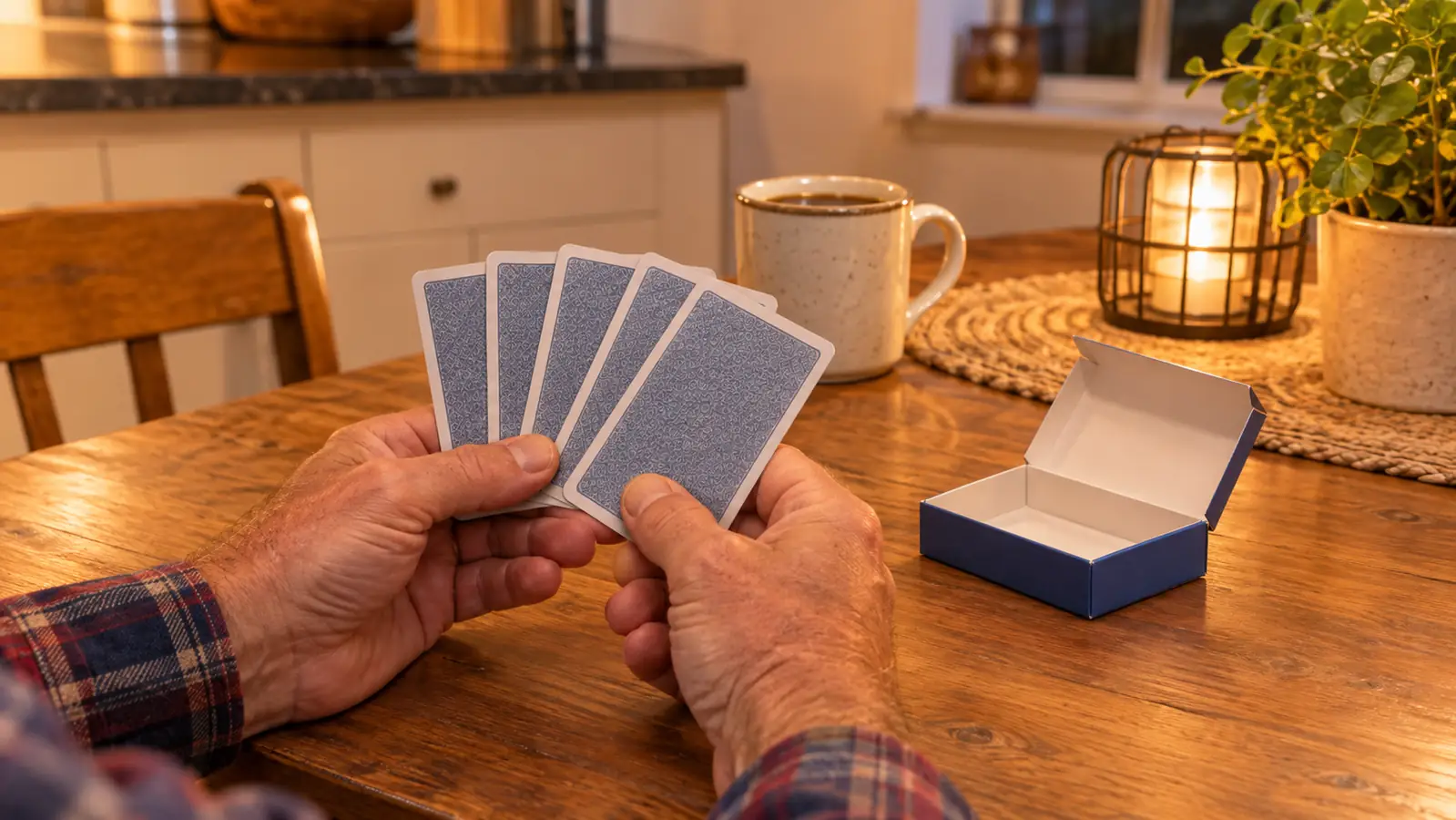
The product page says the trick-taking design keeps either player from grabbing an unfair advantage, and mostly I believe it. The scoring pushes you to fight for a middle band of tricks rather than the most, so a hot hand is not automatically a winning hand. Marcus has beaten me badly and then lost the next round by a wider margin with the same deck and the same person shuffling.
Mostly is doing real work in that sentence. This is still a card game. You can play well and lose because the cards in your hand did not line up, especially in the first few evenings before you have learned what the deck can do. If losing to a bad draw sours your whole night, you will have one of those nights inside the first month. The trade is the good rounds, when you can see a plan coming together three tricks out and actually pull it off.
The bigger ask is attention. This is not a game you can play while half watching something on the television, because every card your partner lays down tells you something about what they are holding and what they are trying to do. On a week when Marcus has had a rough day, that is the whole point. It pulls him off the couch and into the room. On a week when I am the tired one, I have folded a round early and asked to just sit and watch, which the game does not really support, because there is nothing to watch.
Winning Less on Purpose Takes Getting Used To
Here is the part I would want a friend to tell me before I bought it. Taking every trick is a mistake. The scoring rewards a narrow band, and if you overshoot it you can finish a round with nothing to show for good cards. That is the tension the whole game runs on. You are not trying to win. You are trying to win the right amount, which means sometimes you throw away a trick you could have taken, and you have to do it while making it look like you could not.
Marcus found that infuriating for the first three sessions. He plays cards the way he plays everything, which is to win first and think about it later, and the game kept correcting him in a polite way. Then something clicked, and he started doing it to me. The last round we played, he threw a card he could have won with, I believed him, and I lost by two points. He was unbearable about it. I would not trade that evening for a better one.
He threw a card he could have won with. I believed him. I lost by two points, and I have thought about it all week.
That is the honest case for the game. It asks two people to pay attention to each other and to be a little sly about it, and it does that in half an hour with a small box. Not much in our house does that, and the things that do tend to cost a great deal more than a card game.
What It Does to an Ordinary Friday
I want to be careful here, because this is where a review of a card game turns into a review of a marriage, and I am not qualified for that. What I can tell you is what changed in our house. Friday used to end with both of us on the sectional, two different screens, and a conversation that started at ten and lasted four minutes. Now it ends with a game on the island and a conversation that is mostly about cards but is not only about cards. The game did not fix anything. It gave us a reason to sit across from each other instead of next to each other.
There is a specific kind of tired where you want company but you do not want to talk about your day, and this game fits that mood exactly. You are doing something together. You are not being asked to summarize your week. Marcus will tell you more about his afternoon over a hand of cards than he will over dinner, which I have stopped trying to explain and started just using.
The other thing it does is end. Half an hour and you are done, or you deal again and you are done at an hour. It has a shape. A show has a shape too, but a show has a next episode button, and we are both bad at stopping. A deck of cards does not autoplay.
The Box, the Table, and the Ten Minute Teach
The box is small and light. Renegade Game Studios lists it at 0.16 kilograms, which is a few ounces, and lists the size as small and the game as portable. Both hold up. It lives in the drawer next to the coffee maker and it goes to my mother's house at Thanksgiving. The cards are cardstock, and the listing says there is no warranty, so if you are the household that leaves cards on the floor for a kid to step on, be a little careful with them.
The listing gives two players, ages 10 and up, English language, and a fairy tale theme. Our 11-year-old son can follow the rules, so the age recommendation is fair. That said, this is a two-player game and the two players here are the two adults after the kids are in their rooms. We have not used it as a family game and I would not, mostly because the third person at that table is left out on purpose.
A note on the theme. The art carries it and the rules do not. Nobody at our table is role-playing a fairy tale. If you are buying this for someone who wants a story with their cards, this is not that. If you want a tight little card game that looks pleasant sitting on the island, it is exactly that.
Where It Gets Fiddly
Three complaints, and I think all three are fair. The first is that the card abilities take a few plays to hold in your head. The cards carry their own rules, so you are not flipping through a booklet in the middle of a round, but you will be reading every card you draw for the first two evenings, and it slows the pace down. It resolves itself. It does not resolve itself on night one.
The second is the luck, which I have already covered, but it deserves a second sentence because it is the reason some people bounce off this game. There are rounds where one of you has a hand with no plan in it, and the other person wins without doing anything clever. Across a night it evens out. Inside a single round it can feel unfair, and it can feel unfair in front of a partner who will absolutely bring it up.
The third is that it is a two-player game and only a two-player game. No four-player version, no teams, no expansion that turns it into a party. When the kids are older and we want a game for the whole table, this is not that game. When it is just the two of us on a Friday, the limitation is the point.
What I Liked
- Teaches in about ten minutes, so it actually gets played on a weeknight
- Every card your partner plays tells you something, which keeps both people in the room
- The listed 30 minutes is 30 minutes in practice
- Small and light enough to live in a drawer and travel in a weekend bag
- The scoring rewards restraint, which makes the last trick genuinely tense
Where It Falls Short
- Card abilities take a few evenings to learn by heart
- Luck matters more than the balanced-design claim suggests
- Two players only, with no way to include the kids or another couple
- Losing on purpose is a skill some people resent learning
- Cardstock cards and no warranty, so a careless household will wear them out
What We Compared It To
Before this, our two-player default was a set-collecting game with more luck and much more table space. The Fox in the Forest is faster to set up, faster to teach, and shorter, so it gets played more. If you are deciding between the two, there is a straight head-to-head against Jaipur on this site that does the work row by row. The short version is that this one is smaller and tighter for a tired Friday, and the other is deeper if depth is what you are after.
For the longer view of how the game holds up over a season rather than a weekend, there is a separate write-up on long-term play. What I would add here is the thing I did not expect, which is that the game made our Fridays deliberate. We plan them now. A small box in a kitchen drawer is not a big thing, but it is a thing that happens because somebody put it there.
Who This Is For
Two adults who are tired and want to be in the same room for half an hour. Couples who have run out of shows and are not looking for a hobby, just a better Friday. People who like card games with some bite and do not need a board, a story, or a table full of pieces. Anyone who wants something that travels, since the box is small and light enough for a weekend bag.
Who Should Skip It
Skip it if losing to a bad draw ruins your night, because this game will do that to you now and then. Skip it if you need a game for four people or for a family with kids at the table. Skip it if your partner treats a rulebook as a personal challenge and you would rather not spend the first evening reading card text out loud. And skip it if what you want is a couples activity with no competition in it, because this one is competitive down to the last trick, politely.
If your Friday looks like ours, this earns the drawer space
Two players, thirty minutes, one small box. Ours has paid for itself in evenings that did not turn into the couch and a phone.
Amazon Check Today's Price on Amazon →