
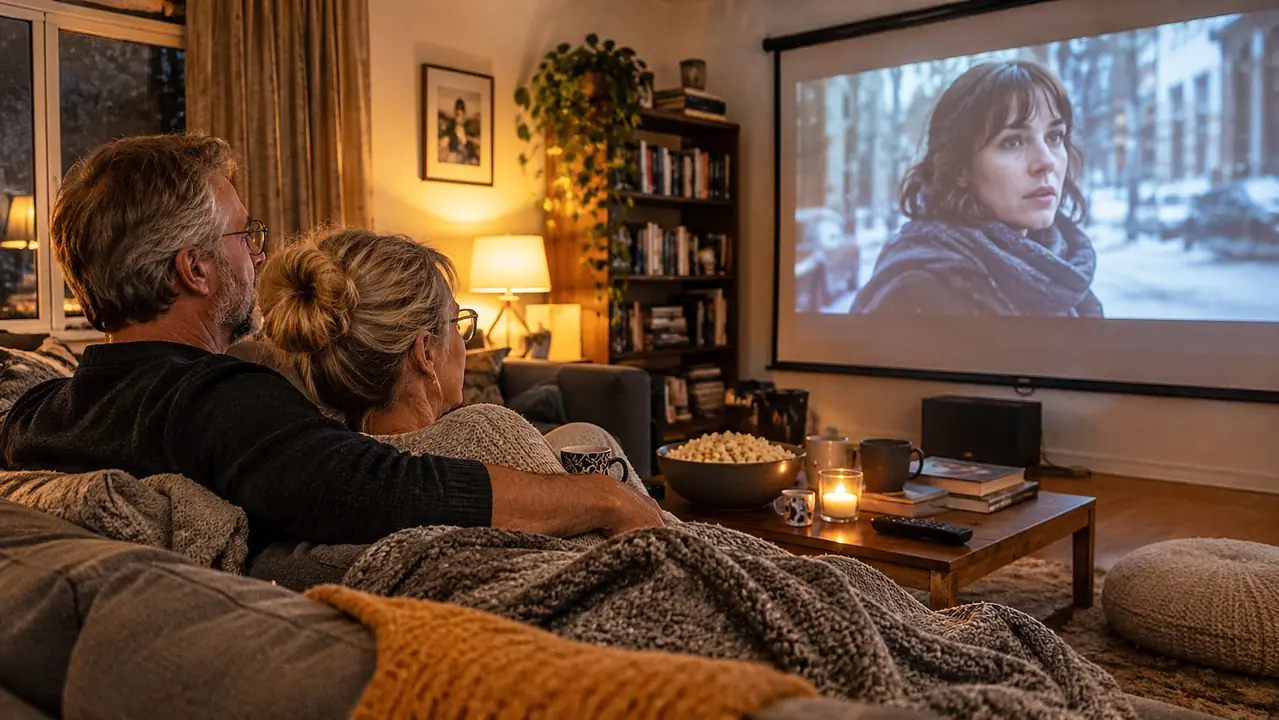
The first thing I want to say about the TMY mini portable projector is that it is not a television. That sounds obvious. But most of the disappointment I read in reviews comes from people who bought a small projector expecting the picture from the 55-inch set in the living room, and then felt cheated when they did not get it. We have had ours since the spring, set up and taken down more times than I can count, and it has earned a permanent spot in our Friday routine. It has also made me roll my eyes twice. Both things are true, and you should hear them together.
Here is the situation it solved. Marcus works HVAC service, so he is out the door before five most mornings. By the time the kids are in their rooms on a Friday, he is flat on the sectional with one shoe off. Our at-home date nights had turned into me picking a movie and him waking up for the closing credits. I did not need a product to fix our marriage. I needed a reason for both of us to sit up and pay attention for two hours. A projected picture does that in a way a television does not, because the screen is a thing you put up on purpose.
The Quick Verdict
A genuinely useful little projector with a sharp native 1080p picture and a screen in the box. It needs a dark room, and it will never replace your TV.
Amazon Check Today's Price →If your living room needs a reason to feel like an occasion, start here
Native 1080p, an 80-inch foldable screen in the box, and Bluetooth speaker mode for the nights you do not watch anything at all.
Amazon See today's price on Amazon →What Nobody Tells You Before You Buy a Mini Projector
Brightness is the number that decides everything, and it is the number nobody explains. The TMY lists 300 lumens. In a dark room at night, blinds down and kitchen light off, that is plenty for the 80-inch screen that comes in the box. The picture looks solid, the colors hold up, and the dark bars around a widescreen movie disappear into the wall. Turn on the lamp in the corner, though, and the same image goes gray and flat. This is not a flaw in the TMY specifically. It is what 300 lumens means, and it is the single thing I wish someone had said to me plainly before I ordered.
The other number worth understanding is resolution. The box says native 1080p, and native is the word that matters. The panel is actually 1920 x 1080, so you are not watching a smaller image stretched to fit. Text in a menu is readable. Faces have edges. When we watched a nature documentary, the water looked like water. Plenty of inexpensive projectors advertise 1080p supported, which means they take a smaller image and blow it up. This one does not do that, and on a screen this size you can see the difference immediately.
The throw distance math is friendlier than I expected, and it matters more than people think when they are standing in a store trying to picture their own living room. The listing gives a maximum of six meters, which sounds like a lecture hall number. In practice our couch sits about three meters from the fireplace wall, and from there the picture fills the 80-inch screen with room to spare. You do not need a long room. You need one blank wall. The first spot I tried was the kitchen island aimed at the long wall across from it, and that failed for a reason that had nothing to do with the projector, which is that the island is where the mail and the school folders live and I was relocating a small pile of paper every single time.
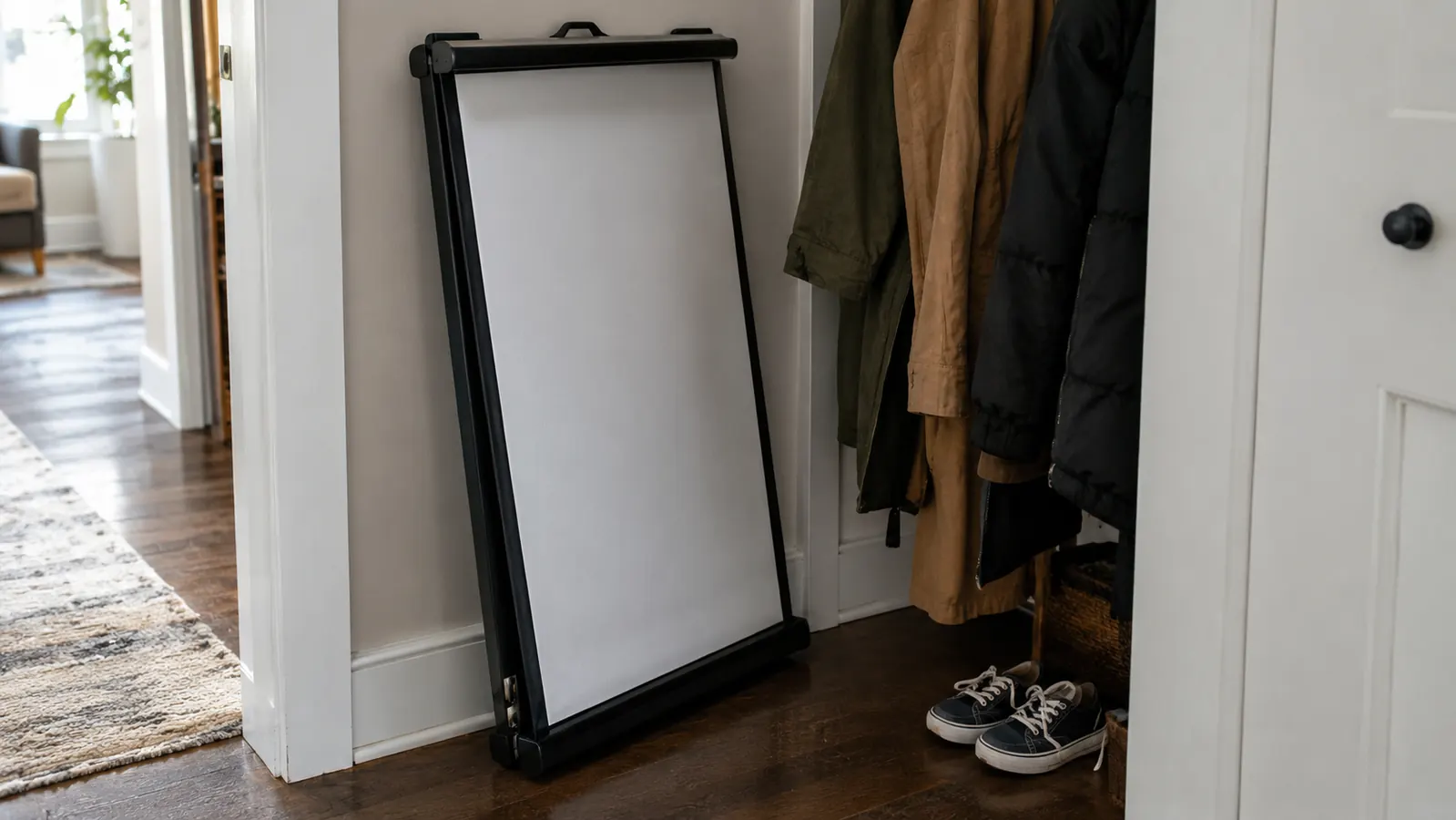
Third thing, and it is the reason I picked this model over a cheaper one: the screen is included. An 80-inch foldable screen comes in the box. That sounds like a throwaway line until you look at what a screen costs on its own and realize the bundle is doing real work. Ours hangs from two hooks above the fireplace wall and pulls down flat. It has a crease down one side from being folded in shipping, which softens after a few weeks of hanging. Not gone. Softened.
Setting It Up Took One Entire Friday Night
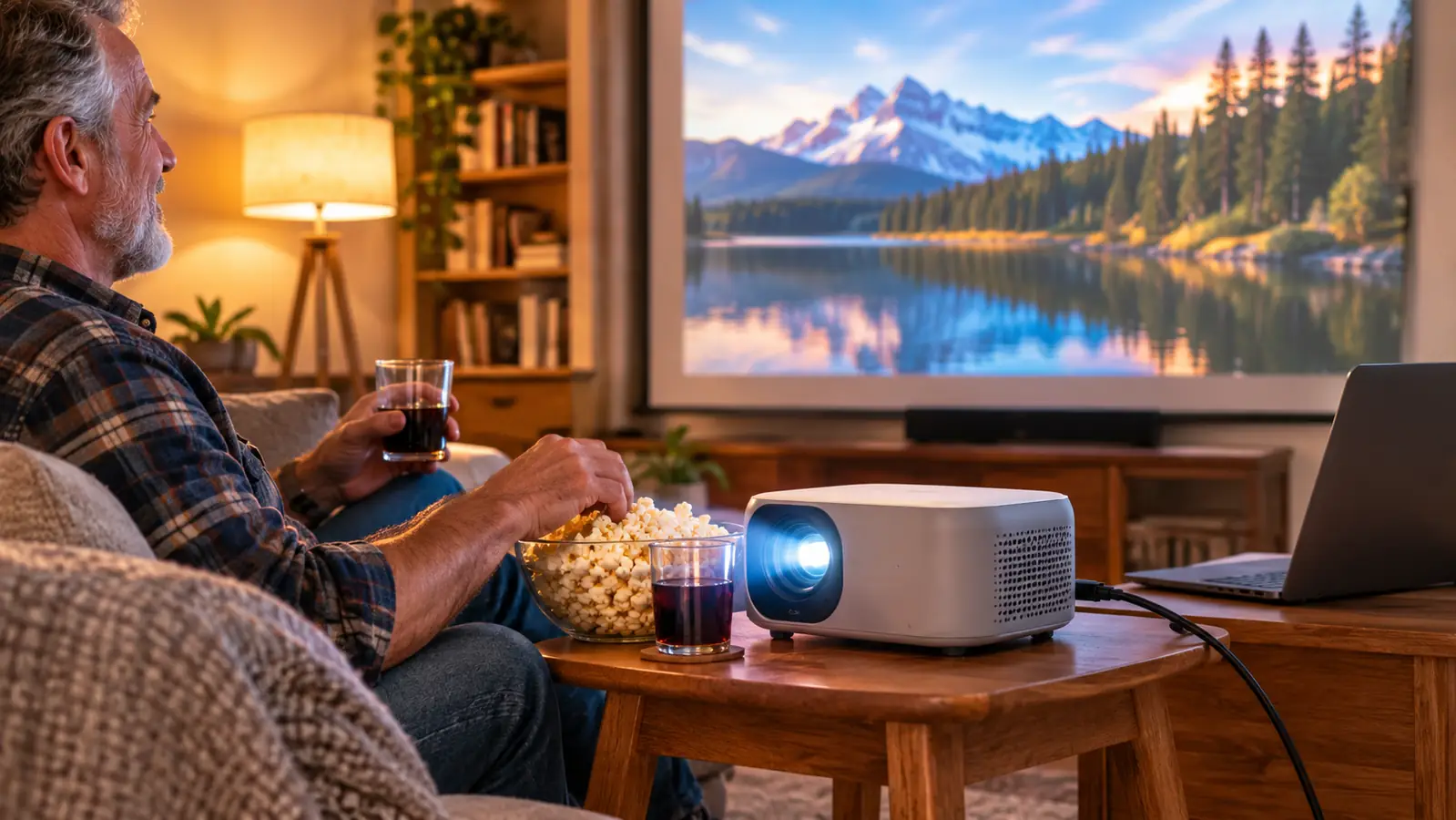
The first setup was a project, and I am not going to pretend otherwise. Hanging the screen, finding a height that worked with the couch, running a cable from the laptop, discovering the cable was too short, finding a longer one. The TMY itself sits on a small wooden stool in front of the fireplace, aimed at the wall with the screen pulled down behind it. That first night cost us the whole evening, and we watched forty minutes of a movie before Marcus fell asleep anyway.
For the record, my first cable was a three-foot HDMI that came with something else, and it forced the laptop onto the floor where anybody walking past could kick it. The replacement is long enough that the laptop now sits on the end table by the lamp, out of the traffic path. I also tried propping the projector on a stack of cookbooks for the first week, which lasted until the night Marcus put his feet up and the whole stack slid sideways mid-scene. The stool is stable, it puts the lens at roughly couch height, and I already owned it, so the total extra spend on this setup was one cable.
The second time took ten minutes. That is the honest shape of it. Once the screen is up and you know where the projector goes, the routine is short: move the coffee table back, set the TMY down, plug in the laptop, press the button on the remote, walk the projector a few inches left or right until the picture squares up with the screen. Nothing about that is difficult. It is just manual, and it is the same ten minutes every time, which is the trade you make for a picture that big at that size and that weight.
The remote is the only control, which is fine and occasionally irritating. It runs the menus and playback, and it is small enough that it lives in the end table drawer so it does not vanish into the couch cushions. The projector itself is easy to pick up with one hand. The listing puts the item weight at 100 g, which I assume is a shipping figure typed into the wrong field, because ours has more heft than that. Either way it moves easily and it goes back on the shelf when we are done.
Where the Picture Holds Up, and Where It Doesn't
Good conditions: dark room, one movie, nobody talking. The picture is crisp, the colors run warm rather than washed, and the 10,000:1 contrast ratio does real work in night scenes. We watched a thriller with a lot of dark hallway shots, and I could actually see the hallway. On the older television in the corner I would have been guessing at shapes.
Bad conditions: anything with the lights on. We tried a football game on a Sunday afternoon with the blinds open and gave up in the second quarter. We tried a recipe video in the kitchen during the day and could not see the pan. If your plan is daytime viewing, this is the wrong purchase, and no amount of adjusting will rescue it. That is not a knock on the TMY. It is physics with a small lamp.
The best night we have had was in early June, the first hot Friday when the kids were at my mother's overnight. We pulled the screen down, opened the back door for air, and watched a two-hour movie start to finish without pausing once. What surprised me is that we could not begin until nearly 8:45, because the summer light dies slowly through those west windows and the picture stays milky until the room is genuinely dark. In January we can start at six. That seasonal gap is a real planning detail, and if you have younger children on a bedtime it matters far more than any number printed on the box.
Motion is fine for movies and shows. During a fast hockey sequence I noticed a little smear behind the puck. Marcus did not notice. Our son, who notices everything, said the puck looked like it had a shadow. For a Friday night film it never came up again, and I have stopped worrying about it.
The Sound Surprised Me, and Then Bluetooth Surprised Me More
The built-in speaker is better than a small box has any right to be. Dialogue is clear at normal volume, and we have not needed subtitles for anything except a British crime series where everyone mumbles by design. It does not fill a room the way a soundbar does, and at higher volumes it thins out. For two people on a couch three meters away, it is enough, and it is one less cable to trip over. The fan is audible if a scene goes quiet, a low steady hum you stop hearing after about ten minutes and then notice again during a long silent shot in the woods.
The part I did not expect is the two-way Bluetooth. When the projector is not showing anything, it works as a standalone speaker. We use it on the back patio in the summer, paired with a phone, and it handles music fine while we sit outside with the citronella going. That is a second use for the same purchase, and it is the reason the thing stays out in the open instead of getting buried in a closet with the other gadgets that seemed like a good idea in March.
There is also a 3.5mm jack and USB and HDMI ports, and the listing says it works with a laptop, a tablet, a gaming console, and a smartphone. We have only used the HDMI and the Bluetooth. If you have a pile of older devices, the ports are there, and the 110 volt rating means it plugs straight into a standard wall outlet without a converter.
Four Months In: What Has Held Up
Four months of Fridays plus a handful of weeknights. Nothing has broken. The screen still hangs, the projector still turns on, and the remote still works from the far end of the couch. The only wear is on the fold crease, which is now a faint line rather than a ridge, plus a small scuff on one corner that I will get to in a second.
That scuff came from a Saturday in July during a thunderstorm, when the power flickered, the movie stopped, and Marcus stood up too fast and caught the cable with his foot. The projector went off the front edge of the table and landed lens first on the rug. I was certain that was the end of it. It came back on with the scuff and nothing else, and it has run fine every Friday since. I now run the cable along the back edge of the table instead of across the front, and it has not happened again, though I would not call that a design flaw so much as a lesson about coffee tables and feet.
The bigger test was whether we would still use it in July. New things get used for a month and then quietly stop. This one survived because the setup is short enough to be worth it on a tired Friday. If it took twenty minutes every time, it would already be in the closet behind the waffle maker. Ten minutes is the difference between a habit and an ornament.
What I Liked
- Native 1920 x 1080 picture instead of an upscaled image, and it shows in faces and text
- 80-inch foldable screen included in the box, which saves a separate purchase
- Bluetooth speaker mode gives it a second life as a patio speaker
- Light and small enough to move with one hand and put away
- Clear dialogue from the built-in speaker at normal volume
- Remote control plus HDMI, USB, and 3.5mm jack cover the usual devices
Where It Falls Short
- Needs a genuinely dark room, lamps off, no daylight
- Fan hum is audible in quiet scenes
- Easy to knock out of alignment on a coffee table
- Summer evenings cannot start until the room is properly dark
- The 100 g weight on the listing is not accurate
The picture is sharp because the panel is actually 1920 x 1080. The room is the thing that decides whether you get to see it.
Who This Is For
This suits a household with one dark-ish room, a wall or a spot for a screen, and two people who want an evening to feel deliberate. It suits people who already have a laptop or a console and no interest in buying a second television. It suits anyone who wants a big picture for a kids movie night, or a backyard showing once the sun is fully down. Ours earns its keep on Friday and sits quietly the rest of the week, which is exactly the job I bought it for.
It also suits the couple where one person falls asleep early. There is something about a pulled-down screen that keeps Marcus upright past nine in a way the television never did. I cannot explain it. I can only report it.
Who Should Skip It
Skip it if the room is bright. Skip it if you want to watch the game at two in the afternoon with the blinds open, because you will not see it and you will blame the projector. Skip it if you expect the built-in speaker to carry a room of eight people having a conversation. And skip it if you are the sort of person who will be bothered by a low fan hum in quiet scenes, or by a picture that needs to be re-aimed after someone bumps the table, because both of those will happen on a regular basis.
Skip it too if you want one device that does everything without you touching it. The TMY is not that. It wants a cable, a wall, and a dark room, and it asks you to press a couple of buttons. That small amount of ceremony is the point for us. If it sounds like a chore to you, buy a bigger television instead and be honest with yourself about it.
What I'd Tell a Friend
I would tell her to buy it for a specific reason, not as a replacement for anything. Buy it because you want Friday to feel different, or because you want a big screen for the one movie a month you actually sit down for. Put it in the darkest room you have. Hang the screen and leave it hung. Buy a longer HDMI cable than you think you need, and something stable to set the projector on so nobody kicks it out of line. Then stop fiddling and watch something.
I would also tell her the honest version of what changed. The television goes off, the screen comes down, and both of us are looking at the same thing instead of one of us half watching and the other half scrolling. That part is not the TMY's doing. It is just easier to commit to an evening when there is a small ceremony around starting it. The projector makes the ceremony cheap and quick, and that turned out to be the whole thing.
Four months of Fridays later, it is still the first thing we reach for
Native 1080p, the 80-inch screen in the box, and Bluetooth speaker mode for the weeks when nobody wants to watch anything.
Amazon See today's price on Amazon →