

Friday night at our house used to end the same way. I would set the last plate in the drying rack, Marcus would stretch out on the sectional, and by 9:30 he would be asleep with the television on. Nothing was wrong. Nothing was planned, either. Our conversation had shrunk down to logistics: who was driving our son to practice, whether anyone had changed the furnace filter, what we were eating on Tuesday. Eighteen years in, we could run a household together in total silence.
Here is what took me a while to admit. The problem was not that we had nothing to say. It was that by nine o'clock neither of us had the energy it takes to find something to say without help. Open-ended conversation needs a running start, and a weeknight does not give you one. What we needed was something that made the first question somebody else's job. That turned out to be the WE'RE NOT REALLY STRANGERS Couples Edition card game: 150 cards, three levels, two players, and about 15 minutes of playing time listed on the box. It is rated for ages 15 and up, which matters in a house with a nosy 11-year-old who materializes whenever a deck comes out.
We had tried the other version of this first. I once printed a list of deep questions off the internet, and we got through four of them before the conversation turned into a review of the list. Marcus kept asking whether a real person had written them. That is the trouble with a printed list: it feels like homework, and homework has a way of making Saturday feel like a staff meeting. A deck is different. It has a beginning, it has levels, and it stops when you stop.
The Deck That Gave Us a First Question
150 cards, three levels, two players. Ours lives on the kitchen island, and it is the reason Saturday has a shape now instead of a television show.
Amazon Check Today's Price on Amazon →Step 1: Pick the Night and Defend It Like an Appointment
Our first attempt was a Friday. That was a mistake, and I knew it about ten minutes in. Marcus works HVAC service and his mornings start before six, so by Friday night he is running on fumes and a sandwich. He was not being difficult. He was tired. We moved our night to Saturday and everything changed, because Saturday he can stay up past ten without paying for it on Monday morning.
The second thing I had to do was tell the kids out loud that the night was taken. Our 15-year-old did not care and did not want details, which is the correct response from a 15-year-old. Our 11-year-old needed a plan, so we gave him one: screens off at 8:45, in his room, reading or listening to something until he falls asleep. Saying it early in the week made it normal instead of dramatic. By the time Saturday arrived the expectation was already set, and I was not negotiating at the counter with a deck in my hand.
Then the phones. Mine goes on the charger in the bedroom. His goes by the coffee maker, which is far enough away that neither of us can reach for it without visibly standing up. This sounds small. It is the whole thing. You cannot ask another person a real question and then look at a screen while they answer it.
One more thing about the night: pick the same one every week, or close to it. We landed on Saturday because it is the only evening in our house where nobody has an early morning waiting on the other side. A standing night does not need to be romantic. It needs to be predictable, so that neither of us has to bring up the idea of talking, which is its own awkward conversation.
Step 2: Clear the Island and Set the Room
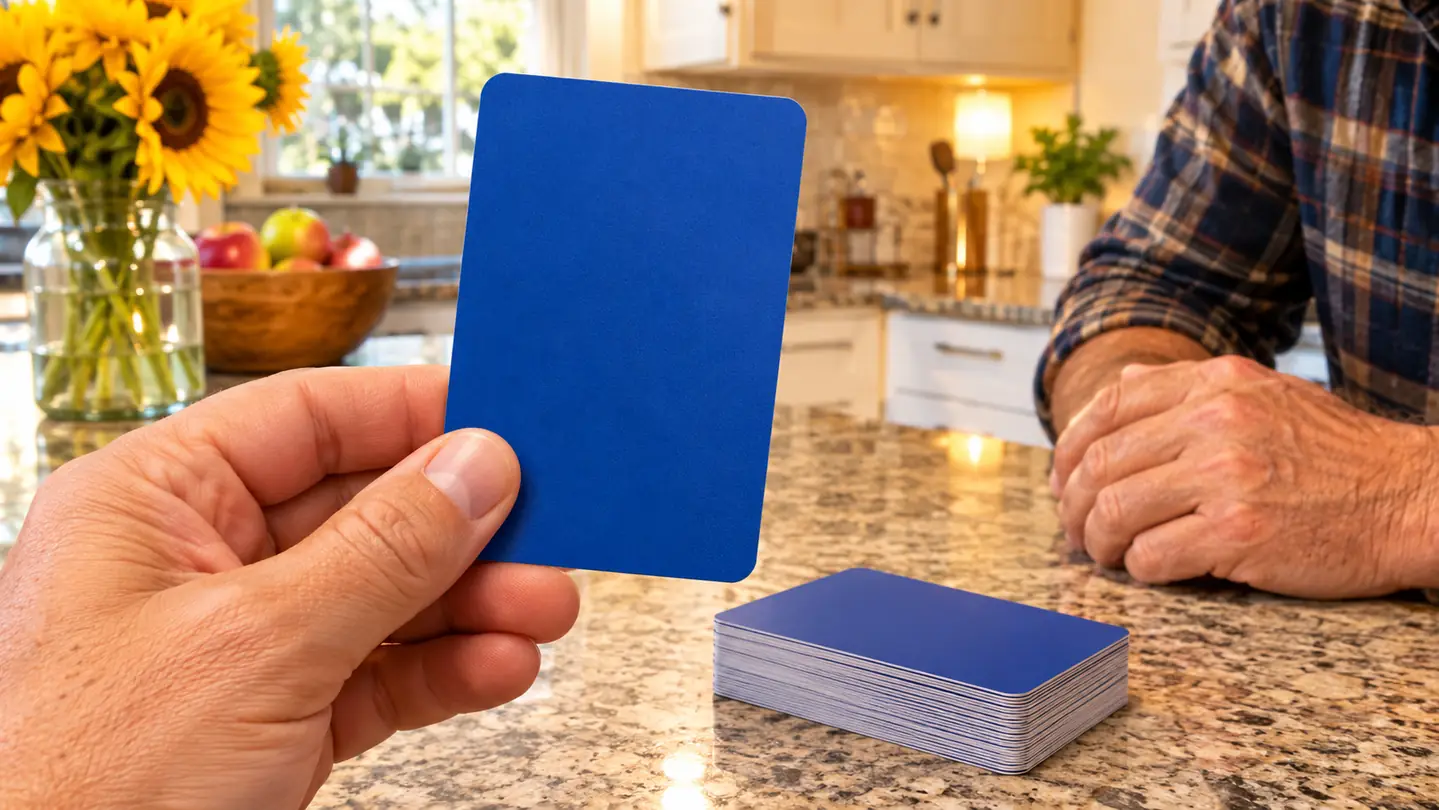
We use the kitchen island, mostly because it is the one surface in our house that can be emptied in under two minutes. I clear the mail, the school folder, the charging cable, the sunscreen bottle that lives there for no reason I have ever understood. Two stools. One lamp instead of the overhead light, because overhead light makes a kitchen feel like a dentist's office. Two glasses of something, and the deck face down in the middle.
The stools matter more than I expected. We have two at the island and one of them wobbled for a month, so I finally fixed it, because a wobbling stool is a distraction that has nothing to do with the cards. Small physical annoyances are what pull a conversation apart at nine o'clock at night. Fix the wobble, put the mail in a drawer, and the room stops asking for attention.
The television stays off, and we do not turn music on for the first ten minutes. I know that sounds like a lot of rules for a card game, but the room is doing work here. If we sit down at a cleared counter with a lamp on and nothing else competing for attention, the evening feels chosen. If we sit down on the couch with the television on, one of us starts answering in half sentences and the other starts watching the show over the top of the cards.
Keep the deck where you can see it during the week. Ours sits on the island in a stack, not in a drawer. A game in a drawer is a game you played once, in March. A game on the counter is the thing you reach for on a Saturday when the kids are at a grandparent's house and there is nothing worth watching.
Step 3: Start at Level 1 Even When You Want to Skip Ahead
The WE'RE NOT REALLY STRANGERS deck is built in three levels and the box explains them plainly. Level 1 is about perspective, how your partner actually sees you, which sounds soft until you are three cards in and realize you have been assuming something about yourself for years that your spouse never believed. Level 2 holds the rarely asked questions, the ones that get you past the version of each other you show at dinner. Level 3 is reflection, what you learned about each other and about yourselves.
The temptation, especially if you have been together a long time, is to flip straight to Level 2 or 3 because Level 1 feels like small talk. Do not. Level 1 does the job of getting both of us talking about ourselves out loud, which we do not do anymore without a reason. The first time we played, I answered a Level 1 card in about twenty seconds. Marcus answered the same card for close to a minute and a half. That does not happen if you open with the heaviest question in the box.
Some nights we stay in Level 1 and put the deck away early. That is a fine night. It is not a failure. The point was never to reach Level 3. The point was to have a conversation that was not about the furnace filter, and Level 1 clears that bar without any effort at all.

Step 4: Answer the Card in Front of You Instead of Grilling Each Other
The way we play it, one person draws and reads the card out loud, and then we both answer it. That is the only rule we keep. Nobody interviews anybody. If Marcus answers a card and I immediately ask two follow-up questions, he starts giving shorter answers, and I know exactly why, because it stops being a conversation and starts being a deposition.
You are also allowed to skip a card without justifying yourself. We agreed on that the first night and it has held ever since. One card asked about something from before we met, and I could tell Marcus did not want to go there on a Saturday, so we moved on and neither of us made it a thing. A deck of 150 cards can spare one.
Do not police the clock either. The WE'RE NOT REALLY STRANGERS Couples Edition lists about 15 minutes of playing time on the box, and we have never once finished in 15 minutes. Ten cards runs us close to 40, and one night we looked up and it was nearly midnight. The 15 minutes is there for people who think they do not have time. It is not a limit you have to enforce. When the conversation has momentum, let it go past the cards and just talk.
The first Saturday we played, Marcus answered one Level 1 card for close to ninety seconds without looking at the ceiling. I had not heard him talk about himself for that long in a year.
Step 5: Write Down One Line Before You Put the Deck Away
This is the step I almost left out, and it is the one I would keep if I could only keep one. Before the cards go back on the counter, we each write a single line in a notebook that lives in the island drawer. Not a summary of the night. One sentence about something the other person said. It takes ninety seconds and it is the difference between a nice evening and a thread you can pick back up.
The first few lines in our notebook are not profound. One says, in my handwriting, that he wishes he had taken the job in Cleveland back in 2011. Another says, in his, that I should stop apologizing for the kitchen being messy when his mother comes over. That second one has come up three times since, and it has made those visits easier.
The notebook is why the night carries into the week. On Tuesday I can open it and ask Marcus about the thing he mentioned on Saturday, and it lands differently than a general how was your day, because I am asking about something specific he told me. He does the same to me, usually in the truck on his lunch break.
On the second night, move to Level 2. That is where the rarely asked questions sit, and a little practice makes them land better than they would have on day one. We did Level 1 for two Saturdays before we went further, and I would do that again, because the warm-up is the part that makes the deeper cards work.
And if you miss a week, which we do, do not turn the missed week into a conversation about why you missed it. Just put the deck back on the island and start again the next Saturday. The habit survives the gap. What kills it is treating the gap as evidence that the whole thing does not work.
What Else Helps
Two things help more than any card in the deck. The first is a hard stop on the planning. If we spend twenty minutes deciding whether we feel like playing, we have already burned the energy the game was supposed to save. The deck is on the counter, the kids have a plan, the phones are in the other room. The plan for the evening takes about four sentences, and then it is happening.
There is also a short version that works on weeks when you only have twenty minutes and no energy for a full night. Draw three cards, answer them at the counter while the coffee is still hot, put the deck back. Some weeks that is the entire date. It still counts, and honestly, some weeks it is the only version that was ever going to happen in our house.
The second is lowering the stakes in your own head. The WE'RE NOT REALLY STRANGERS deck is a card game. It is not a relationship overhaul, and it will not fix a hard year. What it does is make a Saturday night at the kitchen table easier to start, and after 18 years of marriage, easier to start is most of the battle. Warm up in Level 1, answer honestly, skip what you need to skip, write one line down. The rest is the two of you, and nobody at the table is keeping score.
One Deck, One Cleared Counter, One Saturday
150 cards, three levels, 15 minutes on the box and usually longer in practice. Start at Level 1 on a night when nobody has an early morning.
Amazon Check Today's Price on Amazon →